

Key takeaways
- In this market, pseudo often refers to mitragynine pseudoindoxyl.
- A nickname alone cannot confirm what someone took.
- Changing from 7-OH does not establish that dependence concerns have resolved.
- Bring the entire substitution history to a medical assessment.
| Topic | What families should know |
|---|---|
| Full name | Mitragynine pseudoindoxyl |
| Other labels | MGPI, MP, or pseudo in the relevant context |
| Evidence | Laboratory research and findings in tested products |
| Identification limit | Packaging and appearance do not verify every batch |
“It's just pseudo” is not much information when a spouse or child appears unwell. In discussions of 7-OH products, pseudo often means mitragynine pseudoindoxyl, also abbreviated MGPI or MP. Outside that context, the word can mean something else. Start with the full label rather than assuming that a nickname identifies the substance.
For parents of teens and adult children, the immediate questions are usually practical. Is this the same thing as kratom? Does switching from 7-OH mean the person is improving? What should you tell a doctor? This guide separates those questions so an unfamiliar name does not prevent a useful response.
What is mitragynine pseudoindoxyl?
Mitragynine pseudoindoxyl is a kratom-related opioid-active compound. Research has examined its formation from 7-hydroxymitragynine in human plasma under laboratory conditions. That research helps explain its chemistry, but it is not a clinical trial of the tablets or blends sold to consumers (Kamble et al., 2020).
The term “metabolite” can create confusion. A substance's relationship to metabolism does not make a concentrated commercial preparation equivalent to ordinary plant material. The way a compound appears in a laboratory experiment and the way someone consumes a marketed product are different questions.
For family communication, a simple explanation is enough: pseudoindoxyl is a specific compound, and its connection to kratom does not establish the safety of a finished product. You do not need to recite a chemical pathway or compare it numerically with another opioid to justify seeking medical advice.
“Pseudo” is not a reliable pill identifier
A loose tablet, a product nickname, or a screenshot of a seller's page cannot verify contents. Ask for the original packaging if it is available. Record the full ingredient description and any combination terms, especially if the person says the product contains more than one compound.
Avoid posting a photo in a public group and treating the first confident answer as a diagnosis. Even a correct identification of the brand does not establish the contents of that particular batch. A helpful response to a worried relative should acknowledge the limits of visual identification.
If the person has already taken the product, tell medical professionals what the label says and what is uncertain. “The package says pseudoindoxyl” is more accurate than claiming laboratory confirmation. This distinction preserves useful information without making the family responsible for an identification it cannot perform.
How pseudoindoxyl differs from a change in packaging
A loved one may say that switching away from 7-OH means the concern is over. A change in the primary ingredient is meaningful, but it is not a measure of recovery. Ask whether the problems that prompted the switch have changed: daily functioning, spending, discomfort when supplies run out, and the ability to follow through on responsibilities.
It is possible to recognize someone's effort without endorsing the method. “I can see you wanted to get away from the old tablets. I still want us to get advice because you say you cannot get through the morning without the new ones.” That response focuses on the current problem rather than invalidating the person's intention.
Do not use the family budget to test a succession of alternatives. If your loved one asks you to purchase pseudoindoxyl to help them quit 7-OH, offer help contacting a clinician instead. The request may reveal fear of withdrawal that deserves attention, even when the proposed solution is not an appropriate family plan.
Why ingredient disclosure matters
In July 2026, Utah officials identified pseudoindoxyl together with MGM-15 in tested products marketed as cat's claw. The finding illustrates a real mismatch between an herbal label and tested contents. It should not be generalized to every herbal supplement or every product bearing the same broad description (UDAF, 2026).
Ask what evidence exists for the actual product rather than arguing from the plant pictured on the front. A label that says one compound is absent does not identify all remaining ingredients. A report limited to a few analytes cannot answer every question about an unfamiliar blend.
This does not mean a family must commission laboratory testing before acting. Product testing and patient assessment solve different problems. If someone is having symptoms or cannot control their use, arrange care based on those concerns while providing whatever product information is available.
What a useful conversation sounds like
Choose a time when the person is alert and there is privacy. Begin with one observation and one request. For example: “You told me this product keeps you from feeling sick. Would you speak with a clinician about it with me?” A short opening leaves room for information you do not yet have.
Ask what they understand pseudoindoxyl to be. They may have relied on a friend, a seller, or a few online reports. Listen before correcting. If they share a source, look for whether it concerns the same compound, an actual human study, or a specific commercial formulation.
Avoid making the conversation a test of intelligence. Someone can be thoughtful and still misunderstand a product claim. The useful outcome is an agreed next step, such as a call or appointment, rather than a declaration that one person was right about the internet.
Parents of teens: make help accessible
If your teenager has a pseudo-labeled product, involve an adolescent-qualified medical professional. Ask directly about age eligibility and how a parent can participate. Explain to the teen what the appointment is for, who will attend, and what questions you want help answering.
School arrangements should support care without turning the student into a subject of unnecessary disclosure. Ask the clinician what documentation may be appropriate and discuss with the teen what information needs to be shared. A missed assignment and a medical assessment do not require the same audience.
Younger siblings should have a simple safety plan, not a monitoring assignment. Secure unfamiliar products away from them and make sure they know how to get a trusted adult. Keep adult disagreements about blame or treatment out of their role.
Parents of adults and spouses: offer support with clear limits
With an adult, ask what involvement would help. You might organize transport, help compare clinical options, or attend an appointment with consent. Avoid assuming that access to a bank account or a shared home gives you a workable way to supervise every choice.
Set boundaries around actions you control. You can decline to buy another product while offering to help pay an agreed provider directly. You can arrange a different driver if someone appears impaired. State these decisions calmly and consistently instead of making threats that change from one conversation to the next.
If relatives disagree, consider a consultation before bringing everyone into the discussion. A large, unplanned confrontation can overwhelm the practical issue. A coordinated approach gives each person a role and keeps the message focused on assessment and support.
When to seek immediate help
An inability to wake the person or abnormal breathing is an emergency: call 911 and give naloxone if available for suspected opioid overdose. Follow the product instructions and dispatcher guidance. A response to naloxone does not remove the need for emergency evaluation (CDC, 2025).
For other exposure concerns, call U.S. Poison Control at 1-800-222-1222. Use the full term mitragynine pseudoindoxyl if the package provides it, and mention other products or medications. Do not delay the call because you do not know an exact amount.
After an urgent visit, ask who will manage follow-up and what changes require returning for care. It is easy for a family to feel reassured by discharge and then discover that no continuing appointment has been arranged. Make the next contact and timing explicit.
Preparing for ongoing assessment
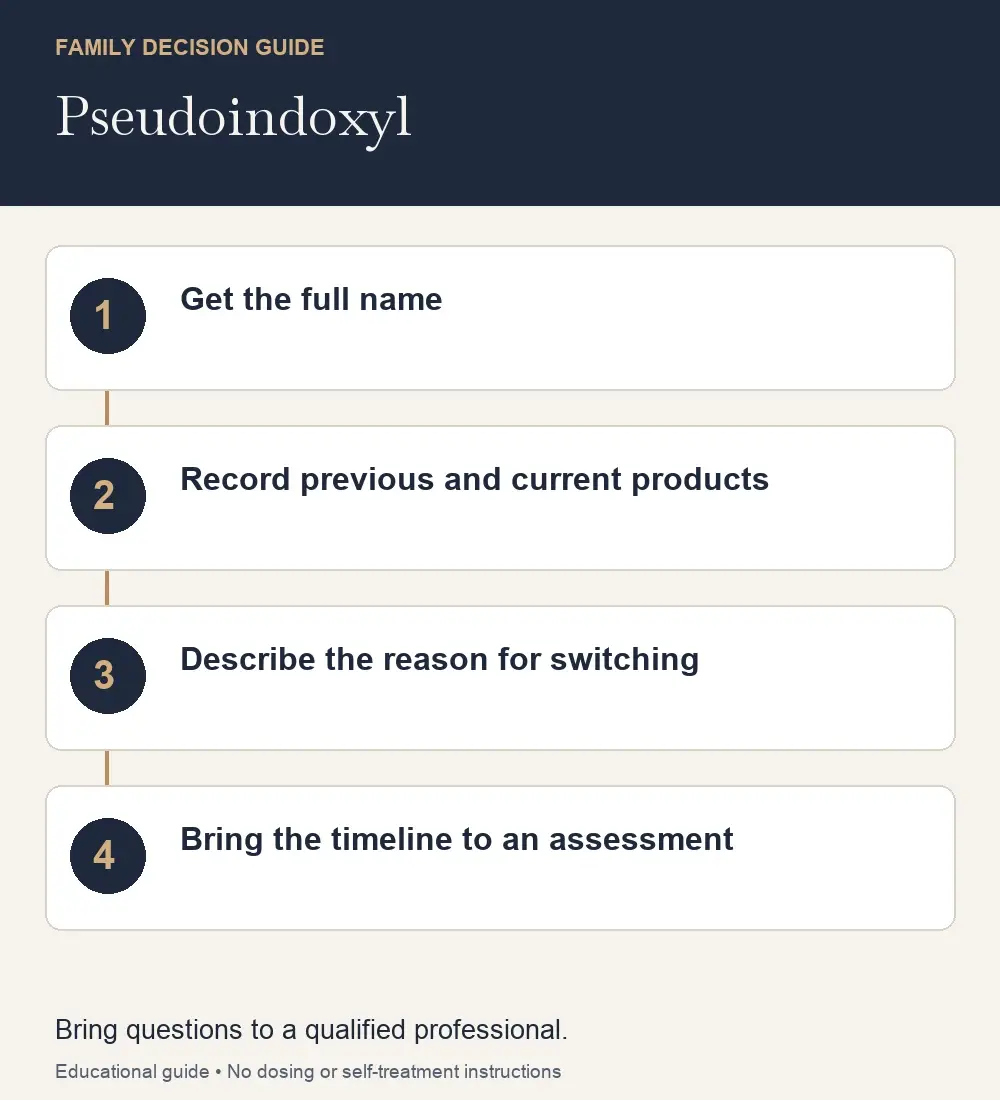
Bring a concise history of the change from 7-OH or other products to pseudoindoxyl. Include the reason for switching, what the person reports now, and any previous attempts to stop. Do not replace missing facts with estimates designed to make the story sound complete.
Ask the clinician about immediate needs, treatment options, and the role of family support. If the person has pain, sleep problems, or anxiety, those concerns should be discussed alongside substance use. A plan that ignores the problem the person was trying to solve may be difficult for them to engage with.
Families can also ask what progress should look like beyond discarding a package. Follow-up attendance, a workable household routine, and honest communication may be more useful subjects than repeated arguments over brand names. The person's treatment team should guide clinical decisions.
How ClearRoute can help a family move forward
ClearRoute offers family coaching and education, crisis intervention, and help coordinating appropriate treatment resources. That support can be useful when a new product name has created confusion or a family is struggling to agree on a response.
ClearRoute is not a laboratory, detox provider, or prescribing service. Medical evaluation remains essential when symptoms or dependence concerns are present. If you have found a pseudoindoxyl product or are worried about a loved one's switch from 7-OH, request a consultation to organize the next steps.
Frequently asked questions
Is pseudo always mitragynine pseudoindoxyl?
No. It can be shorthand in 7-OH discussions, but the word has other meanings. Obtain the full label.
Is pseudoindoxyl just another name for 7-OH?
No. They are distinct, related compounds. A product may also contain a combination, so the complete formulation matters.
Does switching to pseudo mean someone has stopped an addictive pattern?
A new name does not establish recovery. Discuss functioning, difficulty stopping, symptoms, and access to appropriate care.
Should a family wait for a laboratory test before seeking help?
No. Current symptoms and concerns can be assessed while product identity remains uncertain. Emergencies require immediate action.
References
Centers for Disease Control and Prevention. (2025, June 11). Lifesaving naloxone. https://www.cdc.gov/stop-overdose/caring/naloxone.html
Kamble, S. H., León, F., King, T. I., Berthold, E. C., Lopera-Londoño, C., Raju, K. S. R., Hampson, A. J., Sharma, A., Avery, B. A., McMahon, L. R., & McCurdy, C. R. (2020). Metabolism of a kratom alkaloid metabolite in human plasma increases its opioid potency and efficacy. ACS Pharmacology & Translational Science, 3(6), 1063–1068. https://pmc.ncbi.nlm.nih.gov/articles/PMC7737207/
Utah Department of Agriculture and Food. (2026, July 30). Illegal kratom product sold in Utah County linked to death in Utah. https://ag.utah.gov/news/illegal-kratom-product-sold-in-utah-county-linked-to-death-in-utah/
Written by John Ingham. Sources and links checked November 9, 2026. Educational information; individual assessment belongs with qualified healthcare professionals.