
Key takeaways
- Mitraxidine is described in the reviewed material as a proprietary blend name.
- A segmented tablet does not establish prescription-drug contents.
- An exclusion claim is not a complete ingredient list or a safety study.
- Assess the person’s experience rather than assigning an unsupported withdrawal timeline.
| Topic | What families should know |
|---|---|
| Name type | Marketed proprietary formulation name |
| Marketing context | Presented as a 7-OH alternative |
| Not established here | Exact batch composition or comparative clinical safety |
| Family focus | What is claimed, what is verified, and what symptoms exist |
A loved one brings home a new packet and says it is not 7-OH anymore. The name is Mitraxidine, the tablets have a familiar segmented shape, and the explanation is that this is a better alternative. For a parent or spouse who has already spent months learning unfamiliar names, it can feel like starting over.
The central question is not whether the new name sounds scientific. It is what the product contains, what your loved one expects it to do, and whether the problems that prompted concern are changing. A family can ask those questions without pretending that a proprietary blend has a fully established medical profile.
What does the name Mitraxidine identify?
Brooks Healing Center's review describes Mitraxidine as a proprietary kratom-derived blend marketed by BARS. It reports manufacturer claims excluding several named kratom-related compounds. Those statements are marketing information, not independent confirmation of every formulation or batch (Ingham, 2026).
A proprietary name differs from the name of a single chemical. It can identify a branded formulation without telling a parent every active constituent or its concentration. It should not be treated as a synonym for mitragynine, 7-OH, pseudoindoxyl, or a prescription medication.
This is the limit that should guide the conversation. We cannot assign Mitraxidine a reliable human potency, a standard withdrawal schedule, or a proven safety advantage from the name alone. A responsible family response begins by preserving the label and seeking an assessment of the actual situation.
If you found BARS tablets, do not identify them by shape
A rectangular tablet with score lines may remind someone of prescription Xanax bars. Shape can influence expectations, but it does not establish alprazolam content or pharmaceutical manufacturing standards. A loose tablet should be treated as unidentified, even if an online photograph looks similar.
Ask where the packet came from and whether the tablets were stored in their original container. If they were transferred into a bag or another bottle, record that fact. Do not recreate a label from memory or assume that every tablet in a shared container has the same source.
For parents, there is a difference between saying “I found a tablet and need to know whether you took it” and saying “I found Xanax.” The second statement may be wrong and can derail the conversation. Accurate uncertainty makes it easier to obtain a useful account and communicate with healthcare professionals.
What “7-OH alternative” does and does not answer
The phrase describes how a product is positioned. It does not tell a family why the person chose it, whether they can stop using it, or how their health has changed. A replacement can be different without being a medically supported solution to the original problem.
Ask your loved one what alternative means to them. Do they expect less expense, less discomfort, a different effect, or a way to avoid treatment? Their answer identifies the goal you need to discuss. Otherwise, family members can spend hours arguing about ingredients while missing the reason the person keeps returning to the product.
If the goal is relief from pain, anxiety, or difficulty stopping another substance, offer help obtaining appropriate clinical care for that concern. You do not have to endorse a new blend to acknowledge a real need. Nor should you promise that a medical appointment will instantly solve every problem.
| Information | What it may address | What it cannot establish alone |
|---|---|---|
| Ingredient label | What the manufacturer declares | Verified contents of every batch |
| Certificate of analysis | Results within a stated test scope | Long-term safety or treatment effectiveness |
| Tablet appearance | Visual format | Prescription identity or chemical composition |
Read a product claim in three separate parts
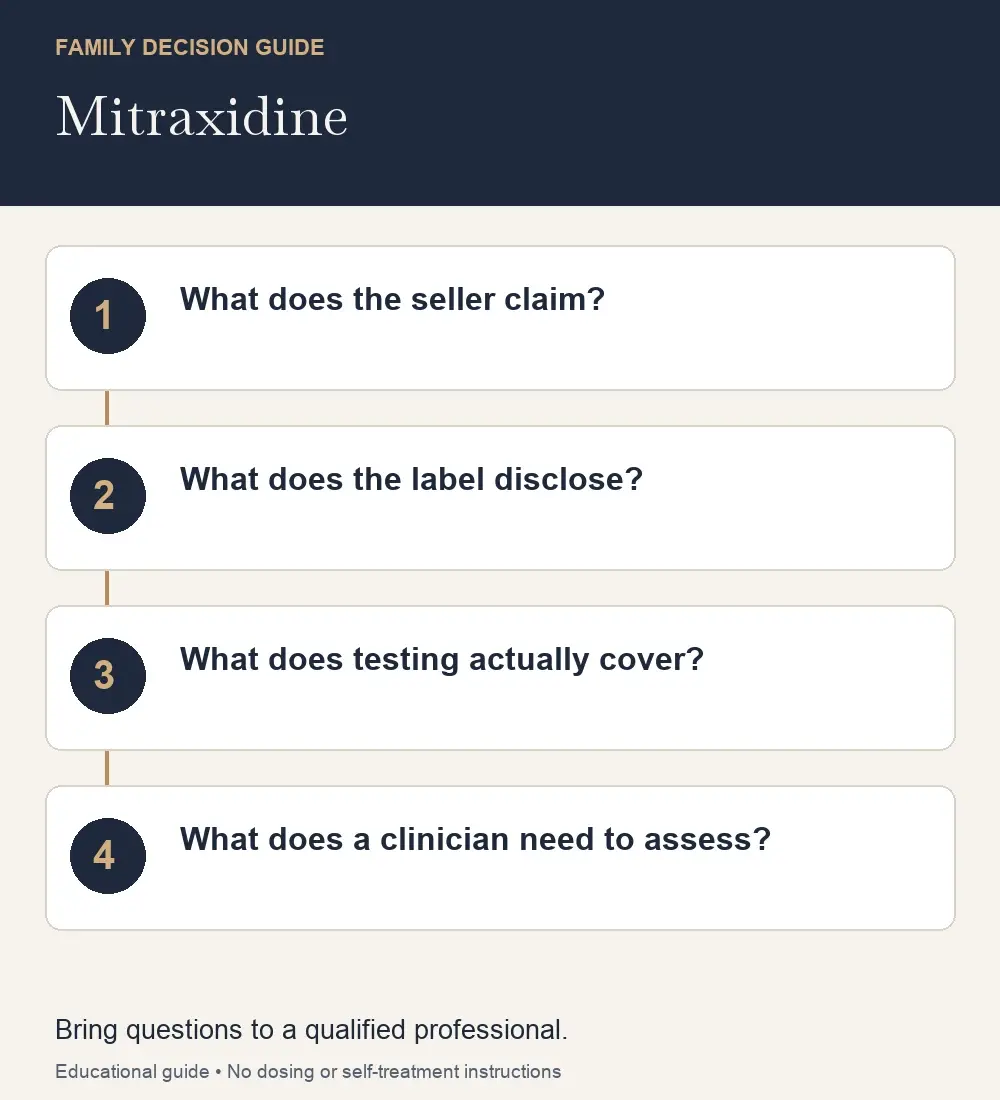
First, identify what the seller says is present. Second, identify what the seller says is absent. Third, look for evidence supporting a health claim about the finished product. These are separate questions, and answering one does not automatically answer the others.
A family might see a statement excluding 7-OH and conclude that there can be no opioid-related concern. That conclusion goes beyond the statement. Conversely, uncertainty does not justify declaring that the package secretly contains a particular drug. Both shortcuts replace missing information with an assumption.
Keep a record of the package actually used, including the date and batch information if available. Advertising can change, and a current webpage may not describe an older purchase. A clinician evaluating an exposure needs the closest available information about the product involved, not a general impression of the brand.
What a certificate of analysis can contribute
A laboratory report is useful only within its scope. Check whether it identifies the same product and batch, what substances were tested, and how the results are expressed. A result describing a bulk sample is not automatically the amount in one tablet or the quantity a person consumed.
“Not detected” is a measurement result with a detection limit, not a statement that every possible active ingredient is absent. A narrow panel may leave other questions unanswered. Ask a qualified professional to interpret technical results rather than trying to turn a screenshot into a safety clearance.
Even a genuine composition report cannot show that a product is effective for treating withdrawal or safe for repeated use in a particular person. Those are clinical questions. The family should not postpone a needed assessment while trying to obtain a perfect set of laboratory documents.
Notice whether life is improving after the switch
Focus on outcomes you can describe: Is your spouse keeping agreed commitments? Is your teen attending school? Does your adult child report feeling unable to function without the product? Has spending become more manageable, or does the household still organize its day around obtaining tablets?
One improvement does not answer every concern, and one difficult day does not establish a diagnosis. Look for the pattern and ask the person to explain it. “You said the new product would help you stop, but you are worried about running out again” is a useful observation without a claim about chemistry.
Avoid setting up a daily interrogation. Agree on a time to discuss the plan and consider involving a professional if every conversation becomes an argument. The goal is to make help more accessible while maintaining boundaries, not to make one relative responsible for detecting every change.
Questions parents can ask without turning it into a trial
For a teen, begin with whether they have taken anything, how they feel, and whether another person may also have used it. Keep immediate safety separate from consequences. If they expect every disclosure to become a public punishment, important information may arrive too late.
For an adult child, ask permission to discuss the concern and offer a concrete form of help. You might say, “I am not asking you to explain every scientific term. I want to understand why you feel you need this and help you get advice.” Respectful language does not mean ignoring concerning behavior.
Do not ask siblings to investigate online accounts or gather evidence. A worried family can unintentionally turn a health issue into a surveillance project. Keep information sharing limited to people who can help and encourage the person to speak directly with a qualified clinician.
What spouses should decide before another purchase
Discuss what shared money will and will not support. A spouse can decline to purchase an unfamiliar product while offering transport to care or direct payment for an agreed consultation. State the boundary in advance rather than using money as a threat during an argument.
Address practical responsibilities, especially driving and childcare, when someone appears impaired. Make arrangements that protect the household without claiming you can determine the exact drug effect. If you feel threatened, prioritize safety and outside support rather than completing the discussion.
You also need a role that can be sustained. Checking every package and staying awake to monitor someone is not a substitute for assessment. Ask for professional guidance about what family participation should look like and how you can step out of responsibilities that require medical expertise.
Symptoms matter even when ingredients remain uncertain
Call 911 for unresponsiveness, serious breathing problems, or a seizure. If opioid overdose is suspected, give available naloxone according to its instructions while help is coming. Report the product name as labeled and say that its composition is uncertain; do not wait to establish a chemical identity.
For suspected poisoning without an immediate life-threatening emergency, call U.S. Poison Control at 1-800-222-1222. Have the packet and timing information ready if possible. Do not give alcohol, sedatives, or another supplement to counter an unfamiliar reaction. Emergency response should follow professional guidance (CDC, 2024).
Bring the substitution history to the appointment
A visit should include more than the newest name. Explain previous 7-OH or kratom use, why the person switched, and what has happened since. Include prescribed medications and other products so the clinician can assess the full picture.
Ask what can be determined now, what remains unknown, and what follow-up is needed. If symptoms are being attributed to withdrawal, ask how other possibilities are being considered. A specific Mitraxidine withdrawal timetable is not established by the materials reviewed for this article, and uncertainty should remain visible in the plan.
A family plan can begin before every ingredient is known
ClearRoute can help organize communication, family coaching, and treatment placement when appropriate. The role is to help a family move toward suitable care, not to certify a product or prescribe a detox method.
If your loved one has switched to Mitraxidine and the same concerns continue, request a free consultation. Bring the questions you have, the information you can verify, and the changes you are seeing at home. A useful next step does not require certainty about every marketing claim.
Frequently asked questions
Is Mitraxidine a single chemical?
The reviewed Brooks material describes a proprietary blend. The name alone does not disclose one verified chemical identity.
Are BARS tablets the same as Xanax?
A similar segmented shape does not establish alprazolam content or equivalence to a prescription. Loose tablets remain unidentified.
Is Mitraxidine safer than 7-OH?
The evidence reviewed does not establish that comparison. Claims excluding certain compounds do not prove the safety of everything else in the product.
Can a certificate of analysis prove a withdrawal treatment works?
No. Composition testing and clinical effectiveness are different questions. A report also applies only within its stated sample and testing scope.
References
Centers for Disease Control and Prevention. (2024, April 2). What to do if you think someone is overdosing. https://www.cdc.gov/stop-overdose/response/index.html
Ingham, J. (2026, October 9). What is Mitraxidine? The “7-OH alternative” and its questionable marketing. Brooks Healing Center. https://brookshealingcenter.com/blog/mitraxidine-7-oh-alternative/
National Center for Complementary and Integrative Health. (2022, April). Kratom. https://www.nccih.nih.gov/health/kratom
Written by John Ingham. Sources and links checked November 9, 2026. Educational information; individual assessment belongs with qualified healthcare professionals.