Key takeaways
- Authentic cat’s claw and kratom-related opioids are different.
- Officials found MGPI and MGM-15 in specific tested products.
- A warning about tested products should not be generalized to every herbal supplement.
- Current symptoms matter more than reassuring words on a package.
| Topic | What families should know |
|---|---|
| Botanical name | Uncaria species |
| Tested-product concern | Undisclosed kratom-related compounds in some products |
| Named investigation | Buzzers products in Utah’s July 2026 alert |
| Important limit | Testing findings are not an inventory of every brand or batch |
A packet labeled cat's claw may look like an ordinary herbal supplement. That is why reports of opioid compounds in some products bearing the name are particularly confusing for families. A parent may believe the packet is harmless because it names a plant, while a spouse may assume every cat's claw supplement now contains a dangerous drug. Neither conclusion is supported by the label alone.
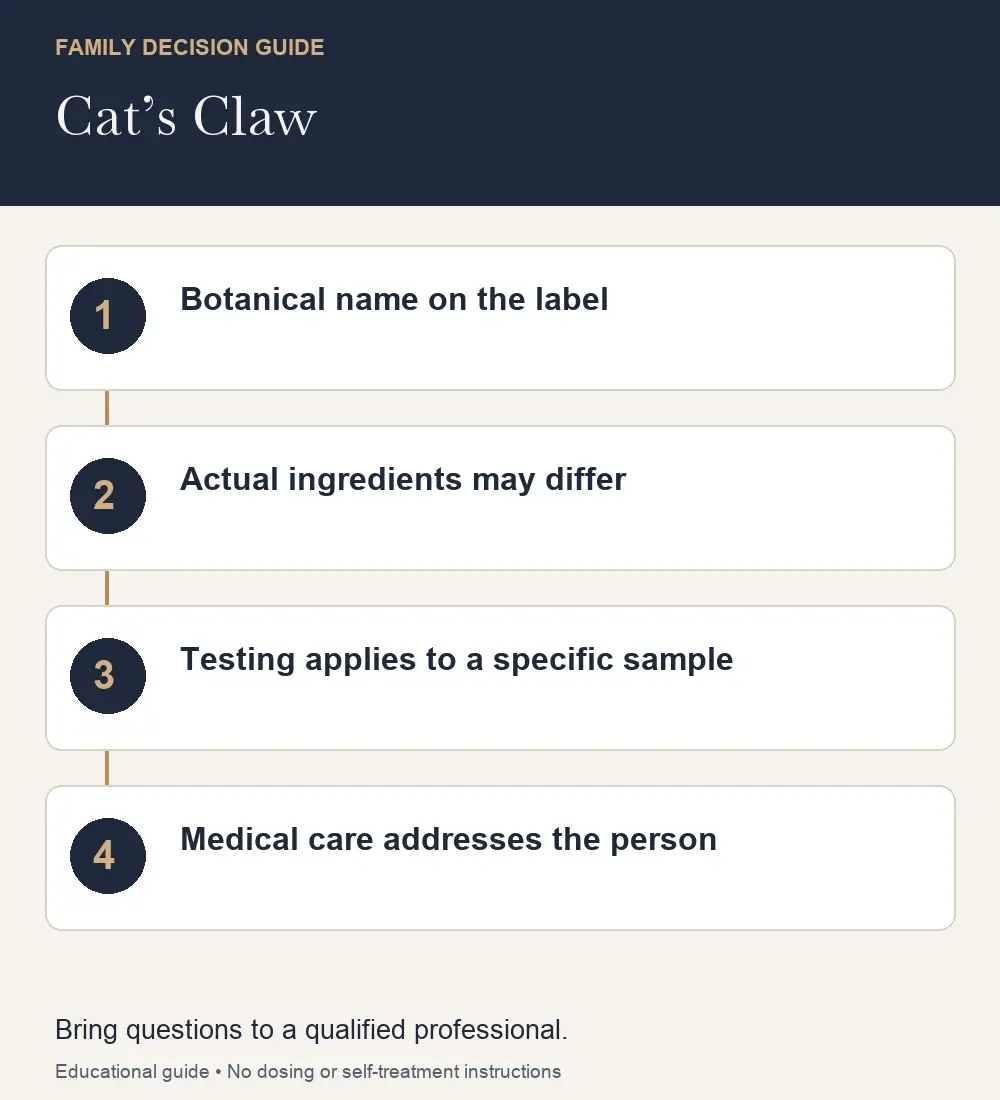
The important distinction is between the botanical and particular products sold under botanical branding. Public-health investigations have identified undisclosed compounds in tested products. Families should understand those findings precisely, then respond to their loved one's condition and the actual package involved.
What is cat's claw, and what is the adulteration concern?
Cat's claw commonly refers to Uncaria species used in herbal products. Genuine cat's claw is different from kratom and from manufactured kratom-related opioids. Washington Poison Center explains that authentic cat's claw is not itself an opioid product and should not be expected to cause opioid overdose or withdrawal (Washington Poison Center, 2026).
The concern is mislabeling or adulteration. A product can use a familiar botanical name while containing other active substances. A family cannot resolve that possibility by recognizing the plant name or comparing a packet's color with a photograph online.
Use careful language when discussing the issue. “Some products labeled cat's claw have tested positive for other compounds” is more accurate than “cat's claw is MGM-15.” That precision matters to a loved one who may know about ordinary herbal preparations and dismiss an overbroad warning.
What officials found in Buzzers products
Utah's July 30, 2026 alert reported mitragynine pseudoindoxyl and MGM-15 in tested Buzzers Cat's Claw tablets. These findings identify substances in the investigated products; they do not provide a chemical inventory for every tablet ever sold under that brand (UDAF, 2026).
The finding is still relevant to families because it shows why a front label cannot be the sole basis for reassurance. If the package in your home resembles a product named in an alert, preserve its details and seek professional guidance. Do not attempt to determine safety by sampling it.
A brand name also should not become the only question you ask. People may change products, remove tablets from packaging, or use a mixture of items. Tell a healthcare professional about all known products and explain which details come from a label, a person's report, or a confirmed test.
How the October warning changed the picture
On October 5, 2026, Utah health officials described four deaths linked to high-potency compounds found in certain herbal supplements and identified MGPI and MGM-15 in the investigation. This is a dated public-health finding, not a national prevalence estimate or proof about every cat's claw preparation (Utah Poison Control Center, 2026).
A family does not need to use the number as a scare tactic. The useful message is that serious outcomes have been investigated and the concern is not simply an internet rumor. Share the official alert and explain the distinction between tested products and untested assumptions.
If your loved one responds that their brand is different, acknowledge that difference. Then return to the unanswered questions about the package they are actually using and any symptoms or dependence concerns. A different name does not settle those questions in either direction.
| Evidence | Supported conclusion | Do not infer |
|---|---|---|
| Utah product testing | Named compounds in tested material | Every cat’s claw product has those contents |
| Botanical label | The advertised category | Chemical confirmation |
| Person’s symptoms | A reason for assessment | A specific ingredient identified by appearance |
“No kratom” is not a complete ingredient explanation
A label may emphasize what a product does not contain. That can create a sense of reassurance without clearly explaining what it does contain. The family should read the entire panel, not only a front-of-package exclusion claim.
Ask whether the person has a batch-specific report and what was tested. A panel covering a small set of compounds has a limited scope. It cannot establish that every other psychoactive ingredient is absent or that the finished product has been shown safe for repeated use.
Do not turn this into an endless search for documentation while someone is unwell. Product verification and medical assessment are separate tasks. The person can be evaluated even if the package information is incomplete, and urgent symptoms should never wait for a seller to answer an email.
If you find tablets in a teen's belongings
First ask whether anyone took them and how they feel. Keep the conversation focused on immediate facts. A teen may know the product only by a nickname and may not have seen the ingredient panel. Give them room to say they do not know.
Do not assume a packet proves regular use, and do not assume a denial proves safety. Seek age-appropriate clinical advice based on the circumstances. A pediatrician or adolescent-qualified provider can help assess the concern and discuss how family involvement should work.
If peers may also have taken the product, share relevant safety information with appropriate adults or professionals without broadcasting private details. Avoid circulating a child's photo or accusations in community groups. The objective is timely care and accurate information, not public identification of who is to blame.
If a spouse switched from 7-OH to cat's claw tablets
Ask what they hoped would improve. Was it access, cost, discomfort, or a desire to stop another product? A switch can represent an attempt to solve a real problem even when the new product's contents are uncertain.
Compare the daily situation before and after the change. Is the person still organizing activities around obtaining tablets? Are they reporting difficulty stopping? Have household responsibilities become harder to meet? Those questions are more useful than arguing about whether the word herbal sounds safe.
You can support the goal of getting better while declining to purchase a replacement. Offer help arranging an assessment and handling practical barriers such as transport or childcare. Avoid becoming responsible for measuring tablets, managing a taper, or deciding whether a new packet is chemically safer.
How to preserve useful information
Photograph the front and back of the package, lot details, and warning language. Keep the original material securely away from children and pets while seeking advice. Do not transfer it to a food container or leave it where someone could mistake it for medication.
Write a brief timeline of the reported exposure and symptoms. Distinguish what the person told you from what you observed. Include other products and prescribed medicines if known. A concise account can help a professional understand the situation more quickly than a collection of unrelated screenshots.
Ask Poison Control or the relevant authority about handling or disposal when a product is implicated in a reaction. Follow professional instructions rather than improvising. If emergency responders are coming, make the package available without delaying the call or leaving the person unattended.
Responding to a suspected overdose
Call 911 for a person who cannot be awakened or is not breathing normally. Give available naloxone for suspected opioid overdose according to its instructions, and follow dispatcher guidance. Tell responders that a product labeled cat's claw may be involved; do not let the herbal wording minimize the symptoms.
U.S. Poison Control is available at 1-800-222-1222 for other suspected exposures and questions. Washington Poison Center's alert recommends urgent attention to the risks from adulterated products (Washington Poison Center, 2026). A person who seems improved after initial help still needs the recommended medical evaluation.
Emergency preparation is best discussed before a crisis. Know where naloxone is stored, how to access it, and who will call for help. Do not place younger children in charge of deciding whether an adult is intoxicated or merely asleep.
After the immediate concern, address the underlying pattern
A reaction or product discovery may be the first time the family learns about ongoing use. Resist trying to settle every issue in the hours after an emergency. Start with the medical plan and a follow-up appointment, then address longer-term communication and household needs.
For an adult child, ask how they want you involved and what practical assistance they will accept. For a teen, confirm that follow-up is appropriate for their age. In both cases, the person's reasons for using the product should be part of the assessment rather than treated as excuses to ignore.
Ask the care team what changes should prompt urgent reassessment and how the family can support attendance. A plan should be understandable enough to use at home. If everyone leaves with a different interpretation, request clarification before the next problem arises.
Help for families facing unfamiliar botanical products
ClearRoute can help families prepare a structured conversation, coordinate treatment placement, and plan aftercare around clinical recommendations. It does not test products, prescribe medications, or provide medical detox.
If cat's claw-labeled tablets have become part of a troubling pattern, you can request a free consultation without first proving every ingredient. Bring the verified information and the questions that remain. The next step is a workable family response connected to appropriate medical care.
Frequently asked questions
Does natural cat’s claw contain MGM-15?
That is not what the alerts establish. They concern adulterated or mislabeled products, not ordinary cat’s claw being the same substance as MGM-15.
Were all Buzzers products tested?
The cited alert reports findings in tested products. It does not establish the contents of every product ever sold under the brand.
Does “no kratom” rule out other opioid-active ingredients?
An exclusion claim is not a complete chemical inventory. The exact ingredients and scope of any testing matter.
What should I do with a suspicious packet?
Keep it away from children and pets, preserve the label for professionals, and ask Poison Control or the relevant authority for handling guidance. Do not sample it.
References
Centers for Disease Control and Prevention. (2024, April 2). What to do if you think someone is overdosing. https://www.cdc.gov/stop-overdose/response/index.html
Utah Department of Agriculture and Food. (2026, July 30). Illegal kratom product sold in Utah County linked to death in Utah. https://ag.utah.gov/news/illegal-kratom-product-sold-in-utah-county-linked-to-death-in-utah/
Utah Poison Control Center. (2026, October 5). Utah health officials warn of fatal overdoses involving illegal “cat’s claw” and kratom product. University of Utah Health. https://poisoncontrol.utah.edu/news/2026/10/utah-health-officials-warn-of-fatal-overdoses-involving-illegal-cats-claw-and-kratom
Washington Poison Center. (2026, October 7). Safety alert: Fake cat’s claw supplements resulting in overdose & severe illness. https://www.wapc.org/insights/safety-alert-fake-cats-claw/
Written by John Ingham. Sources and links checked November 9, 2026. Educational information; individual assessment belongs with qualified healthcare professionals.