
Key takeaways
- MGM-15 is also called dihydro-7-hydroxymitragynine.
- Its research history does not establish safe consumer use.
- Officials identified MGM-15 in specific tested cat’s claw-labeled products.
- A packet is information for assessment, not proof of a diagnosis.
| Topic | What families should know |
|---|---|
| Also called | Dihydro-7-hydroxymitragynine |
| Related compound | MGM-16; a different compound, not an interchangeable strength |
| Evidence distinction | Animal research versus tested commercial products |
| Family priority | Current safety, accurate labels, age-appropriate care |
Finding “MGM-15” on a tablet package can leave a parent with very little useful context. It does not sound like a familiar prescription, and a teenager or adult child may describe it only as a different kind of kratom. The unfamiliar name matters because it refers to a specific manufactured compound, not simply a new flavor or a strain of leaf.
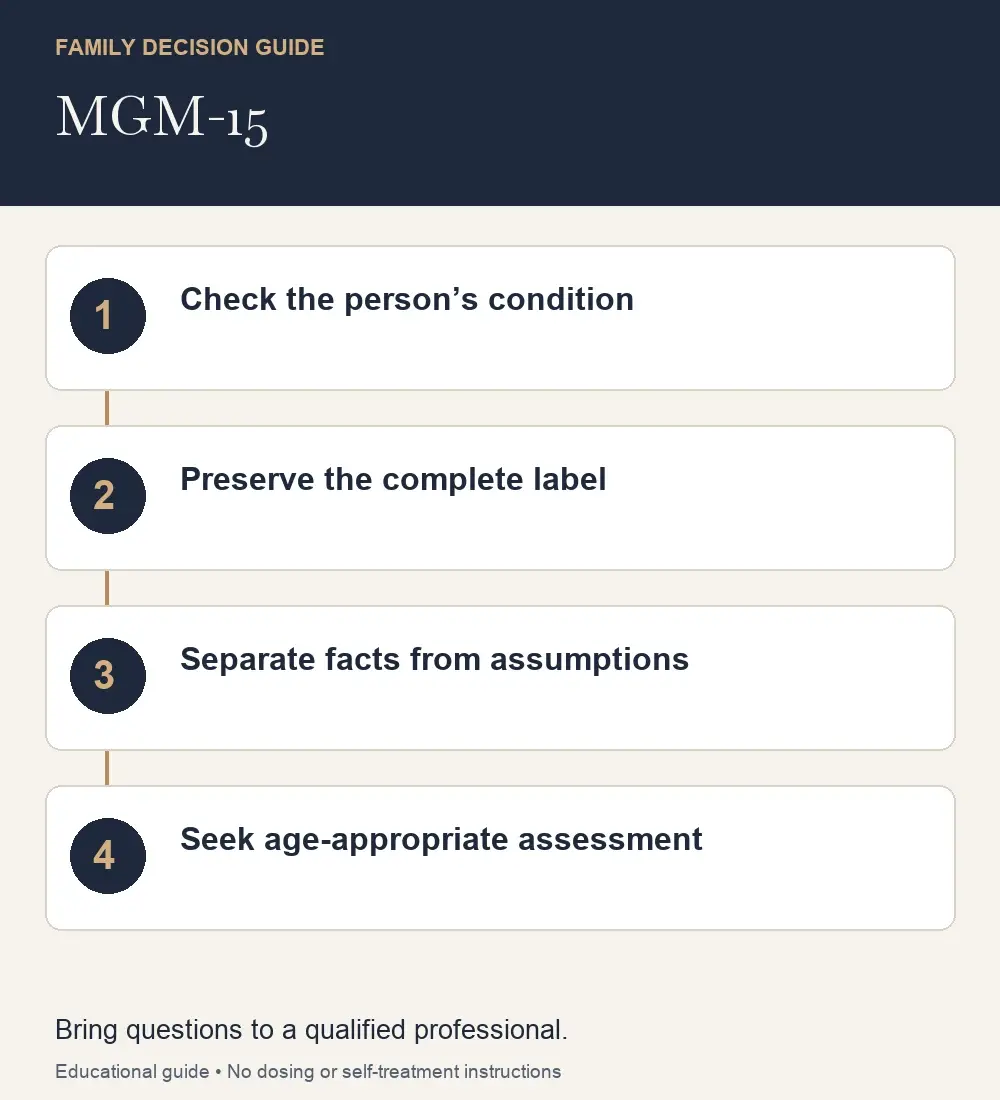
The first family decision is about the person's condition now. If they are alert and safe, there is time to gather information and arrange an assessment. If they are severely unwell, identification can happen alongside emergency care. You do not have to become a chemist before asking for help.
What is MGM-15?
MGM-15 is also known as dihydro-7-hydroxymitragynine. It is a chemically modified kratom-related compound studied for opioid activity. A foundational pharmacology paper investigated MGM-15 and the related MGM-16 in laboratory and animal experiments; those experiments were not trials establishing safe consumer use (Matsumoto et al., 2014).
This history explains why an internet search can return scientific language that sounds reassuring. A compound can be interesting to pain researchers without being an approved medication. Research explores possibilities and limitations under controlled conditions. A retail tablet with a research-associated ingredient is a different situation.
When talking with your child, avoid saying that every kratom product is MGM-15. Ask which product they mean and whether they know the ingredient name. If the label uses an abbreviation such as DHM, preserve the full panel. Abbreviations can have different meanings in different products, so they should not be treated as definitive identification by themselves.
Why MGM-15 belongs in a family safety conversation
MGM-15 is not only an obscure name in an old paper. In July 2026, Utah officials reported MGM-15 and mitragynine pseudoindoxyl in tested Buzzers products labeled as cat's claw. That finding concerns the products tested; it does not establish the contents of every package sold under a botanical name (Utah Department of Agriculture and Food [UDAF], 2026).
The practical lesson is to avoid letting a label end the conversation. “It says herbal” and “It does not say 7-OH” cannot answer every ingredient question. At the same time, a parent should not tell a child that a particular packet definitely contains MGM-15 unless there is evidence for that packet or formulation.
Use the uncertainty honestly: “I cannot tell what is in this from the front of the package. I would like us to show the full label to someone qualified.” This is a stronger position than repeating an alarming claim that your child can easily disprove.
Found a package: what to record and what to leave alone
If it is safe, photograph the product name, ingredient panel, batch number, and any warning text. Keep the material away from young children and pets. Do not taste it, open capsules to inspect powder, or try a small amount to understand the effect. Appearance cannot establish chemical contents.
Ask whether anyone has taken it and when. If your child can answer, let them explain what they believe it contains and what they expected it to do. Record uncertainty as uncertainty. “They said it was a kratom alternative” is useful information; changing that into “confirmed MGM-15 exposure” can mislead the next person assessing them.
A photograph found on a phone is not proof of use, and an empty packet does not show how much one person consumed. Before a confrontation, separate the evidence you have from the story you are building around it. That makes the conversation more credible and leaves room for your child to disclose something you did not expect.
Warning signs should lead to assessment, not a home diagnosis
Pay attention to direct statements about losing control, needing the product to get through the day, or feeling unwell when it runs out. Repeated missed commitments or unexplained spending may also justify a conversation. None of these observations identifies MGM-15 on its own.
For a teen, a falling grade can have many explanations. For an adult child, fatigue or a missed call does not establish substance use. The goal is to connect concrete observations with a question: “You said you felt sick until you got another packet. What has been happening?” That question is more informative than a demand to admit addiction.
Keep a short, factual record if you are preparing for a professional consultation. Dates, exact statements, and observable events are useful. Avoid compiling an exhaustive list of old conflicts. The person helping your family needs to understand the current problem and its urgency, not judge who won previous arguments.
What if your child says MGM-15 is safer than 7-OH?
Ask where that conclusion comes from. A store employee's recommendation, a product review, and an animal study provide different kinds of information. None can establish that an unknown retail product is safer for your particular child. It is reasonable to say that the comparison remains unresolved rather than choosing a dramatic potency number.
The MGM research does not provide a consumer conversion chart. Differences in experimental methods, routes, and species make it inappropriate to translate a laboratory potency claim into a human dose. You do not need to debate receptor terminology to make the family decision: a product with uncertain safety should be discussed with a qualified clinician.
If the switch was intended to avoid withdrawal, acknowledge that motive. “I hear that you were trying not to feel sick. Let us ask about a medical plan for that.” Understanding why the person switched can move the discussion toward care instead of an argument over which product name is worse.
Getting help when the product name is unfamiliar
Call ahead to a medical provider and use the exact name, MGM-15, along with any known prior 7-OH or kratom use. Ask whether they can evaluate the concern or direct you to an appropriate service. Do not treat an unfamiliarity with one brand as proof that medical care cannot help.
Bring current medication information and mention alcohol or other substances honestly. Do not omit a second product because you worry it will make your child look bad. Clinicians need the most accurate account available. If the patient is an adult, invite them to provide their own history and decide how they want you involved.
For an adolescent, confirm age eligibility before planning admission or travel. Ask how the provider works with guardians and how they explain confidentiality to the teen. Clear expectations can prevent the first visit from becoming another conflict about who is allowed to speak.
Know when the situation cannot wait
Unresponsiveness or abnormal breathing requires 911. Give naloxone if available for a suspected opioid overdose and follow its instructions while emergency help is coming. Keep the package available when possible, but let symptoms determine urgency rather than waiting for a laboratory identification (CDC, 2024).
If there is a suspected exposure or reaction without those emergency signs, call U.S. Poison Control at 1-800-222-1222 for case-specific guidance. Explain that the contents may be uncertain. Do not induce vomiting or offer another substance as an antidote. Follow the professional's instructions about evaluation and monitoring.
After emergency care, ask for a clear discharge and follow-up plan. A family should know which changes require returning for urgent help, who is managing ongoing care, and when the next appointment will occur. Leaving with a list of phone numbers is different from having a workable next step.
A conversation that respects both teens and adult children
With a teenager, lead with safety and an appropriate assessment: “My job is to help keep you safe. We need someone qualified to look at this with us.” Avoid making disclosure automatically trigger a public punishment or a group confrontation. A teen who expects humiliation may withhold information that clinicians need.
With an adult child, an offer might be: “I can help arrange a consultation and transportation. I cannot decide for you, but I will not ignore what you told me about feeling unable to stop.” Respect autonomy while being clear about the support you can provide.
Family members should agree on a small number of consistent boundaries before talking. One relative buying replacement tablets while another threatens eviction creates conflicting messages. Consider professional guidance if the family cannot agree on a response. The objective is a realistic plan, not unanimity about every past event.
Moving from identification to a care plan
Once MGM-15 is part of the discussion, the next questions concern the person's needs: current symptoms, other substances, willingness to be assessed, and the support required to follow through. The exact package is important information, but it should not become the only subject the family talks about.
ClearRoute helps families prepare conversations, coordinate treatment placement, and consider crisis intervention when a structured approach is appropriate. Medical assessment and withdrawal treatment belong with licensed clinicians. Parents of teens and adult children can request a consultation to discuss how to move forward without trying to manage the situation alone.
Frequently asked questions
Is MGM-15 the same as ordinary kratom leaf?
No. MGM-15 is a chemically modified kratom-related compound. Do not treat it as simply another leaf strain.
Does DHM always mean MGM-15?
No. Abbreviations depend on context. Preserve the complete ingredient label rather than identifying a substance from three letters alone.
Can a parent identify MGM-15 by tablet appearance?
No. Shape, color, and a matching online image cannot verify chemical contents. Share the original packaging with a professional.
What if my adult child refuses an assessment?
You can still seek guidance about communication, practical support, and boundaries. Emergency help should never depend on whether they accepted earlier advice.
References
Centers for Disease Control and Prevention. (2024, April 2). What to do if you think someone is overdosing. https://www.cdc.gov/stop-overdose/response/index.html
Matsumoto, K., Narita, M., Muramatsu, N., Nakayama, T., Misawa, K., Kitajima, M., Tashima, K., Devi, L. A., Suzuki, T., Takayama, H., & Horie, S. (2014). Orally active opioid μ/δ dual agonist MGM-16, a derivative of the indole alkaloid mitragynine, exhibits potent antiallodynic effect on neuropathic pain in mice. The Journal of Pharmacology and Experimental Therapeutics, 348(3), 383–392. https://pmc.ncbi.nlm.nih.gov/articles/PMC6067406/
Utah Department of Agriculture and Food. (2026, July 30). Illegal kratom product sold in Utah County linked to death in Utah. https://ag.utah.gov/news/illegal-kratom-product-sold-in-utah-county-linked-to-death-in-utah/
Written by John Ingham. Sources and links checked November 9, 2026. Educational information; individual assessment belongs with qualified healthcare professionals.