
Key takeaways
- Enhanced 7-OH products differ from trace amounts in kratom leaf.
- Feeling unable to function without a product warrants clinical assessment.
- A new retail substitute is not automatically a withdrawal treatment.
- Families can support access to care without managing a home detox.
| Topic | What families should know |
|---|---|
| Full name | 7-hydroxymitragynine |
| Article focus | Withdrawal concerns and family responsibilities |
| Key distinction | Physical dependence and addiction are related but not identical |
| Next step | Qualified assessment with the complete product history |
A spouse who says, “I need a 7-OH tablet just to feel normal,” is describing something different from occasional curiosity about a supplement. You may have noticed rushed store visits, a changing household budget, or mornings organized around avoiding discomfort. You do not need to decide whether the right label is addiction before taking those concerns seriously.
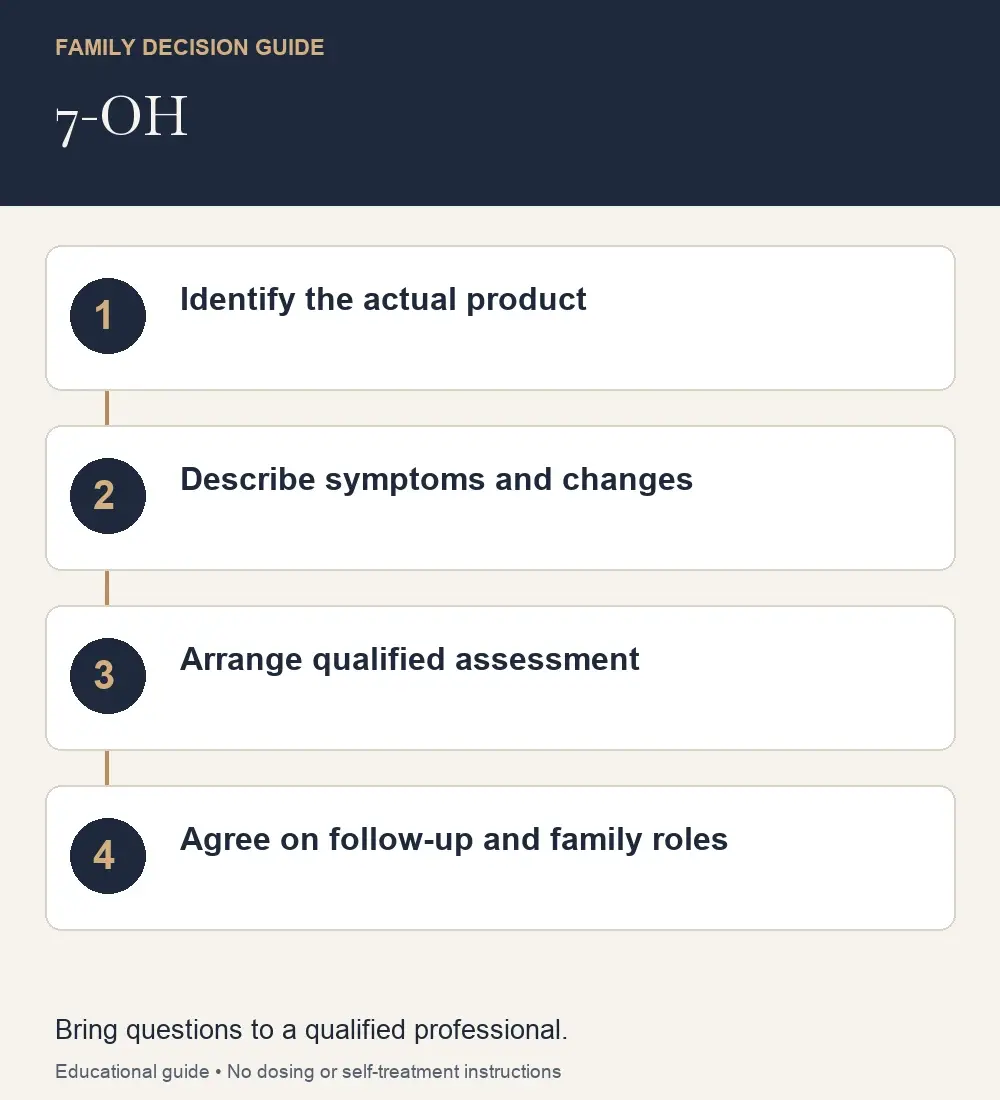
7-OH withdrawal is a medical concern, and a family can help without becoming responsible for a home detox. The most useful first step is to understand what your loved one is actually taking and arrange an assessment that accounts for their health, medications, and other substances. This guide focuses on the practical decisions spouses and parents face when stopping has become difficult.
What is 7-OH, and why does the product matter?
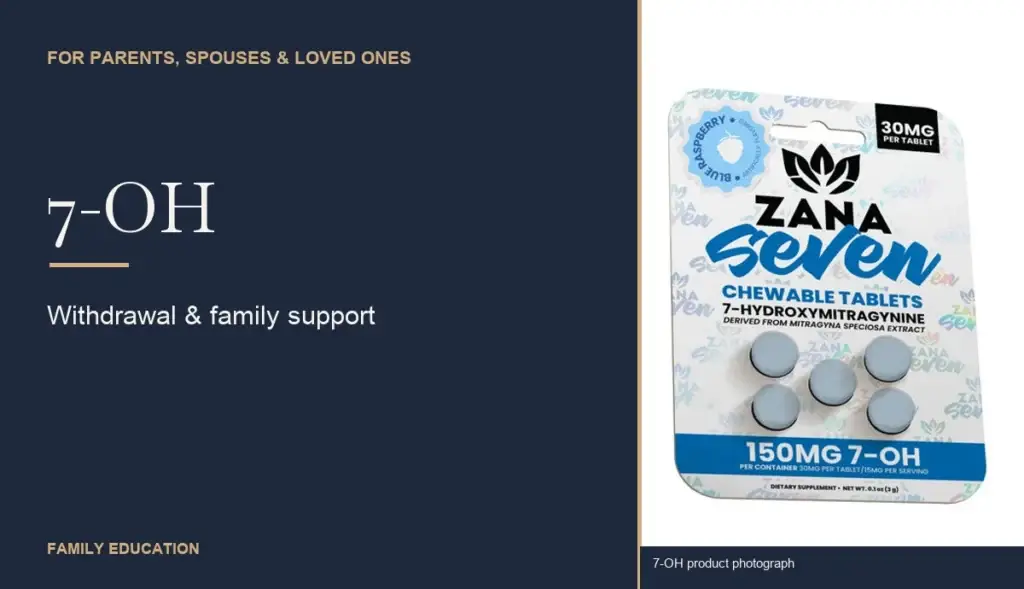
7-OH means 7-hydroxymitragynine, an opioid-active compound associated with kratom. The FDA distinguishes the trace amounts in natural leaf from products with added or enhanced 7-OH. Tablets, shots, gummies, and mixes can fall into the latter category; a familiar retail setting does not make them approved medicines (U.S. Food and Drug Administration [FDA], n.d.).
For a family, the distinction changes the questions to ask. “How much kratom?” may produce an answer that leaves out concentrated tablets entirely. Ask for the actual name, formulation, and label. If your spouse has changed brands, note when that happened. Do not assume that one tablet from the new package represents the same exposure as one tablet from the old package.
A person may have started for pain, stress, or difficulty stopping another substance. Let them explain that purpose without turning it into a debate about whether the original decision was reasonable. Their current problem needs attention even if the reason for starting made sense to them at the time.
When discomfort starts controlling the day
Physical dependence means the body has adapted to a substance; withdrawal can follow a reduction or interruption. Addiction involves a broader pattern of impaired control and continued use despite harm. These concepts overlap, but relatives cannot determine a diagnosis from a package or one difficult morning.
Instead, listen for descriptions of a narrowing routine: “I cannot leave until I get more,” “I tried to stop but could not get through work,” or “I am spending money we need for something else.” Those statements provide a concrete starting point for a clinician. Write down the person's own account rather than assigning a severity score from an online checklist.
The FDA reports withdrawal symptoms associated with 7-OH, including restlessness, aches, fatigue, irritability, and cold sweats (FDA, n.d.). Symptoms alone do not prove the cause. An infection, medication change, another substance, or a separate health problem could also be involved. A family should not explain away every new complaint as “just withdrawal.”
Why a fixed withdrawal timeline can mislead families
You may want a calendar so you can arrange leave from work or tell children when life will feel normal again. That is understandable. However, a universal day-by-day promise is not a reliable way to plan care for an unfamiliar concentrated product. The amount actually taken, the pattern of use, product changes, and other health conditions all belong in the assessment.
Treat a timeline found online as someone's account, not a deadline your loved one must meet. If they remain unwell beyond that timeline, it does not prove they are lying. Conversely, feeling better after a few days does not establish that the underlying pattern has resolved. The family plan should include follow-up rather than ending when visible discomfort improves.
For work and school arrangements, ask the treating clinician what can reasonably be anticipated and when the plan should be reassessed. Keep explanations to employers or teachers limited to what the person agrees to share and what is necessary. Detailed product histories do not belong in a broad family email.
Do not make a replacement product the treatment plan
A switch from 7-OH to pseudoindoxyl, MGM-15, or an unfamiliar botanical blend may sound like progress because the original name disappears. The important question is whether the person has received appropriate care, not whether the packaging is different. An alternative sold online is not automatically a withdrawal treatment.
The American College of Medical Toxicology recommends professional substance-use care for people stopping 7-OH and describes clinical use of medications for opioid use disorder in reported cases (American College of Medical Toxicology [ACMT], 2026). That does not mean relatives should obtain or administer those medications themselves. A qualified prescriber must evaluate whether a medication is appropriate and how to manage it.
Avoid bargaining over which smoke-shop product the family will purchase next. A more useful offer is specific: “I will help arrange an appointment, drive you there, and discuss the cost directly with the provider.” You can acknowledge fear of withdrawal while declining to become the supplier or manager of a substitute.
Separate an emergency from a difficult conversation
If someone cannot be awakened or is breathing abnormally, call 911 and give naloxone if available, following its instructions. Stay with them and follow dispatcher guidance. Do not wait for an argument about the product name to be settled before acting (Centers for Disease Control and Prevention [CDC], 2024).
For other suspected poisoning or exposure concerns, U.S. Poison Control is available at 1-800-222-1222. Tell the professional exactly what you know and what you do not know. Bring packaging or a photograph if it is readily available, but do not delay urgent help to search through a car or phone.
Families should discuss emergency readiness when everyone is alert and calm. Decide where naloxone will be kept, who knows how to use it, and how someone will communicate the home address. This conversation is preparation, not an accusation. Make sure the plan is practical for the people who actually live in the home.
How to talk with a spouse who is afraid to stop
Start with the shared problem rather than a demand for a confession. “We are planning our days around these tablets, and you have said you feel sick without them. I want us to get medical advice about the next step.” Then allow time for an answer. A rapid list of accusations can bury the one concern you need them to hear.
Ask what feels hardest about getting help. It may be childcare, an employer, previous treatment experiences, or worry about being dismissed because the product came from a store. You cannot promise the whole process will be easy, but you can help remove a concrete barrier. Offer to make an initial call together or write down questions before the appointment.
Keep boundaries within your control. You might arrange another driver if your spouse appears impaired or pay an agreed provider directly instead of handing over cash. Avoid promises to monitor them continuously. If a conversation becomes threatening, prioritize your own safety and the safety of children rather than trying to finish the discussion.
Parents of teens and adult children need different logistics
For a teen, start with a pediatrician or an adolescent-qualified substance-use clinician. Ask about family participation, privacy, school coordination, and the appropriate setting for assessment. Do not assume that a program designed for adults can safely meet an adolescent's needs simply because it treats opioids.
For an adult child, ask how they would like you involved. You can offer transport, help organizing information, or participation in a visit with permission. You can also provide relevant observations to a clinician, while recognizing that the clinician may be unable to share information back without consent. Respecting privacy and expressing concern can happen together.
In either situation, protect younger siblings from becoming monitors. They should not be responsible for checking whether a parent or sibling has used a substance or for deciding whether symptoms are serious. Give them a simple plan for getting a trusted adult and emergency help when needed.
What to bring to an assessment
Prepare a short account of product names, recent changes, reported use, current prescriptions, and what happened during previous attempts to stop. Separate what you observed from what you suspect. A photograph of the package can be useful; a long argument about the person's character is not.
Ask the provider how immediate symptoms will be addressed, what follow-up is available, and whom to contact if the situation changes. If a higher level of care is recommended, request the reasons and practical details. Families need to understand transport, admission timing, medication continuity, and what happens after the initial treatment phase.
Building support after the first appointment
A productive first visit is a beginning. Agree on one manageable follow-up conversation rather than checking in every hour. Discuss what support is welcome, what remains the person's responsibility, and which household arrangements need to change while care gets established. Revisit the plan when circumstances change.
ClearRoute can help families organize those decisions through family coaching and education, treatment placement, and coordinated next steps. ClearRoute provides intervention and coordination services, not medical detox or prescribing. If you are unsure how to approach a spouse, teen, or adult child about 7-OH, request a free consultation to discuss a practical family plan.
Frequently asked questions
How long does 7-OH withdrawal last?
There is no single reliable timeline for every person or product. A clinician should assess the use pattern, other substances, symptoms, and health history.
Should I buy another product to help my spouse stop 7-OH?
Do not make an unfamiliar retail substitute the family treatment plan. Offer help arranging medical advice about the symptoms and options.
Can parents get help for a teen using 7-OH?
Yes. Seek an adolescent-qualified medical assessment and ask about guardian participation. ClearRoute can discuss family coordination and appropriate resources.
Does ClearRoute provide 7-OH detox?
No. ClearRoute provides intervention, family support, and coordination with appropriate treatment resources; medical detox and prescribing require qualified clinicians.
References
American College of Medical Toxicology. (2026, August). ACMT position statement: Public health concerns associated with 7-hydroxymitragynine and other kratom compounds. https://www.acmt.net/news/acmt-position-statement-public-health-concerns-associated-with-7-hydroxymitragynine-and-other-kratom-compounds/
Centers for Disease Control and Prevention. (2024, April 2). What to do if you think someone is overdosing. https://www.cdc.gov/stop-overdose/response/index.html
U.S. Food and Drug Administration. (n.d.). Products containing 7-OH can cause serious harm. https://www.fda.gov/consumers/consumer-updates/products-containing-7-oh-can-cause-serious-harm
Written by John Ingham. Sources and links checked November 9, 2026. Educational information; individual assessment belongs with qualified healthcare professionals.
Featured image: Zana Herbals 7-OH product photograph, used for educational identification. The photograph does not identify other products or batches.