
Key points
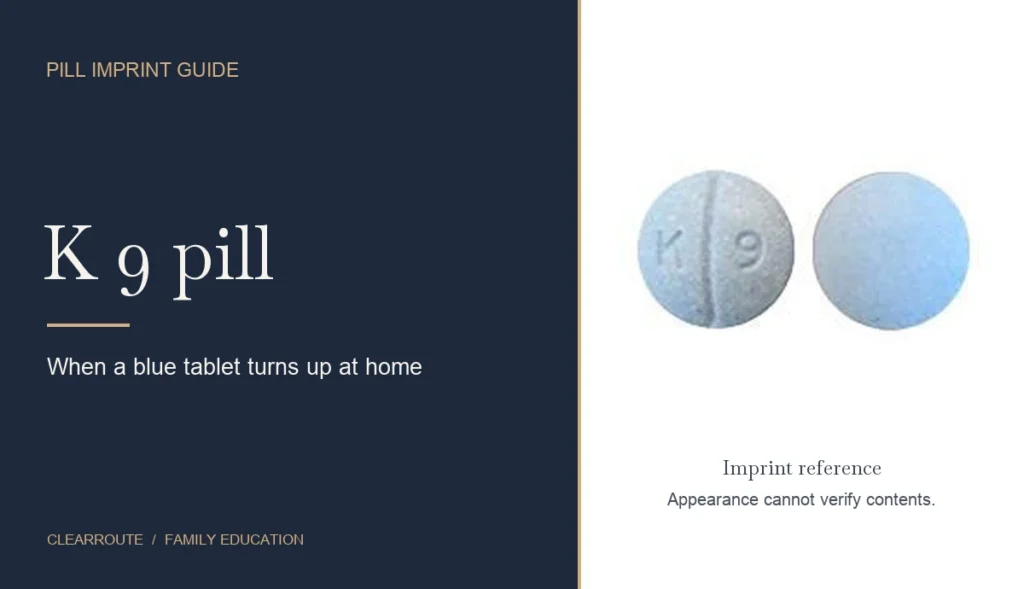
- The prescription K 9 pattern is a K and a 9 on opposite sides of a score on the same face of a round blue tablet. The reverse is plain.
- The matching labeled medicine is oxycodone hydrochloride 30 mg. DEA also documents counterfeit tablets bearing that pattern.
- If an adult child is difficult to wake after taking a pill, act on the breathing emergency rather than waiting for an answer about its source.
An adult daughter tells her father a blue pill in the center console is “a K9.” He hears a confident name; she may only be repeating what someone called it. There are two useful questions here: what does the name refer to, and what evidence is there about this particular tablet? A label can answer the first. It cannot answer the second.
Is K9 the same marking as K 9?
People commonly type the search without a space. The prescription label describes a round blue tablet with K to the left of the dividing line and 9 to the right. Its other side has no imprint. The labeled tablet contains 30 mg of oxycodone hydrochloride. Report the placement of the markings, not just the letters and numbers you think you saw. (National Library of Medicine, n.d.)
The 9 is not a statement of milligrams, and the line is not an instruction for what to do with an unknown pill. A small blue tablet with a different reverse, an unreadable marking, or an edge missing should be described as such. A pharmacist may be able to narrow the possibilities; it is better to say a mark is unclear than to complete the description from a picture.
What the counterfeit evidence says about K 9
This is an imprint for which there is specific laboratory evidence. In its national report on seizures from 2024–2025, DEA lists K 9 separately. Among substances identified in tablets of that type were fentanyl and caffeine; other specimens had different findings. That is evidence that the same outward identity can hide different contents. It is not a personal risk percentage for an individual pill. (U.S. Drug Enforcement Administration, 2026)
For a family, the practical implication is simple: do not ask a relative to take a small piece to see whether it behaves like oxycodone. Do not assume that yesterday’s experience with an identical-looking pill predicts today’s. A tablet does not become less uncertain because a friend recognizes its nickname.
Why a genuine K 9 pill can still be dangerous
Oxycodone is an opioid. A clinician prescribing it considers the individual’s pain, medical conditions, other medicines, and previous exposure to opioids. A tablet from another person’s prescription bypasses that evaluation. Respiratory depression, accidental overdose, misuse, and addiction are risks of the real drug as well as concerns when the source is unknown. (National Library of Medicine, n.d.)
These risks are not a reason to stigmatize someone receiving appropriate pain treatment. If the person has their own prescription but the pill looks unfamiliar, they should call the dispensing pharmacy before taking the questionable tablet. If someone has used opioids repeatedly and wants to stop, a medical professional should assess withdrawal and treatment options. A parent should not design a taper from internet advice.
If the pill was found in a car
Check on the passengers, not just the owner of the vehicle. Was the tablet discovered after a recent ride? Did someone say they had taken a pain medicine? Is anyone unusually sleepy or breathing slowly? If an exposure may have occurred, make the appropriate emergency or Poison Control call with what you know. Do not postpone it while trying to identify which passenger left the tablet.
If everyone is safe and nobody took it, keep the item away from children, avoid handling powder or a damaged tablet, and ask a pharmacist how to proceed. A question about storage or disposal can wait until an exposure concern is resolved. Nobody who may be impaired should drive themselves to seek help.
A conversation with an adult child
Start from the fact you both know: “We found a tablet marked K and 9 in the car. Could anyone have taken it?” Once immediate safety is addressed, try “What did you think it was for?” The answer might be pain relief, avoiding withdrawal, a party, or an account that it belongs to someone else. Each answer suggests a different next step; none verifies what the tablet contains.
Avoid opening with “I know exactly what you took.” That confidently states something you do not know and can undermine the next question. An adult child may be more willing to call a clinician if they can speak privately. You can offer a ride or help finding an appointment without insisting on access to every conversation with their provider.
A parent can also set a clear driving boundary: “If you have taken something and might be impaired, I will arrange another ride. I will not send the children in the car with you.” That decision is about immediate safety. It does not require an admission of addiction.
What to bring to an assessment
A brief timeline is more useful than a collection of search results. Note when the tablet was found, what the person remembers taking, whether alcohol or sedating medicines might have been involved, and whether there have been other episodes of unusual sleepiness or missed obligations. Mark clearly which details came from the person and which are your own observations.
Ask the clinician about the reason your adult child sought a pill outside medical care. Pain after an injury, a lapse in access to a prescriber, and fear of withdrawal all merit attention. If the first provider cannot assess substance use, ask for a referral and what to do while waiting. The family can help with practical barriers while leaving diagnosis and prescribing to the clinical team.
ClearRoute offers intervention planning when repeated attempts to engage someone have stalled and treatment placement support when a family needs help navigating options. You can talk through a plan without first resolving every disagreement about the tablet.
If the K 9 tablet belongs to a teenager
For a teen, the car conversation should lead to an age-appropriate health assessment when use is suspected. A parent can help arrange the visit, explain what they observed, and ask the clinician about private time for the teenager. For an adult child, offer that same practical help while asking permission before joining a visit or coordinating routine care. ClearRoute provides family and intervention support for teens as well as adults. Neither age group should wait for a planned meeting during a possible overdose.
Frequently asked questions
Does a K 9 pill contain acetaminophen?
The referenced K 9 prescription product is oxycodone hydrochloride, not an oxycodone–acetaminophen combination. A loose pill cannot be assumed to contain either ingredient based on the imprint.
Is K 9 the same as M 30?
They are different imprint patterns on documented oxycodone products. They are also separately represented in counterfeit seizure data. Neither pattern authenticates a found tablet.
Can someone who took it just sleep it off?
If they cannot be awakened or are breathing abnormally, call 911 immediately and give available naloxone for a suspected opioid overdose. If they are awake but may have swallowed an unknown pill, call Poison Control now rather than relying on observation alone.
Can I identify fentanyl from the color?
No. The color does not establish whether fentanyl is present. Neither a professional-looking imprint nor a familiar shade of blue verifies the contents.
What if the person insists the pill belonged to a friend?
You can accept that as their account without treating it as proof of a legitimate source. Prioritize whether anyone took it and then arrange safe handling and an appropriate follow-up conversation.
Sources
Centers for Disease Control and Prevention. (2024, April 2). What to do if you think someone is overdosing. https://www.cdc.gov/stop-overdose/response/
National Capital Poison Center. (n.d.). First aid guidelines. https://www.poison.org/first-aid-for-poisonings
National Library of Medicine. (n.d.). Oxycodone hydrochloride tablets [Drug label]. https://dailymed.nlm.nih.gov/dailymed/drugInfo.cfm?setid=aa7ac2bf-d9ed-445d-b394-4d3fe39780ca
U.S. Drug Enforcement Administration. (2026). Counterfeit pills seized in the United States between January 1, 2024 and December 31, 2025. https://www.dea.gov/sites/default/files/2026-10/US-2024-2025%20Counterfeit%20Pill%20Data.pdf
Featured photograph: DEA imprint reference, p. 13. The reference image does not authenticate a found tablet.