
Key points
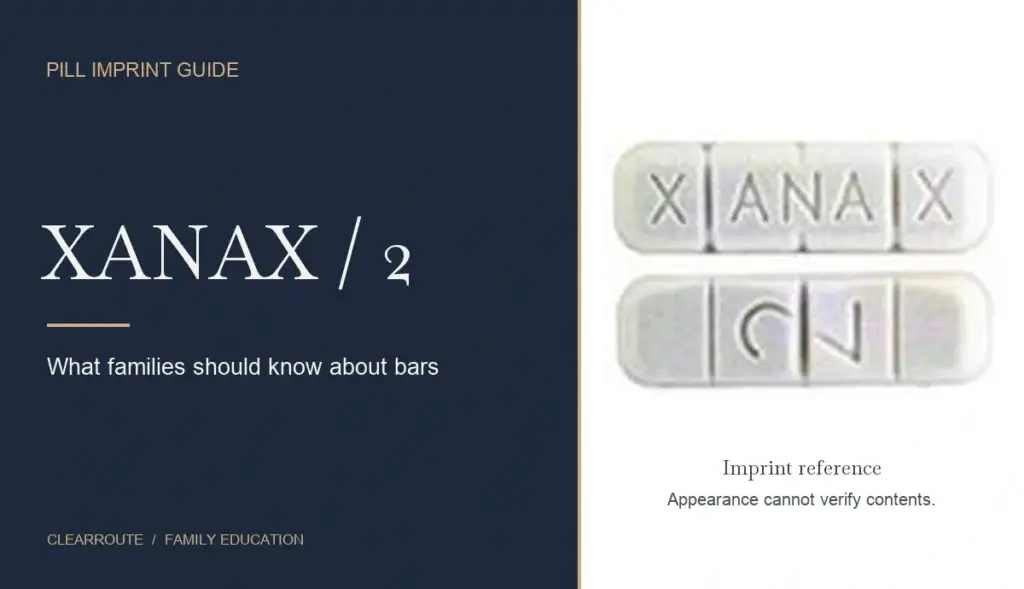
- A documented brand-name Xanax 2 mg tablet is white and oblong, scored into four sections, and marked XANAX and 2. “Bar” is a description of its shape, not proof of its identity.
- Genuine alprazolam can cause physical dependence and carries a risk of addiction. Abruptly stopping after regular use can cause dangerous withdrawal.
- A loose bar sold as Xanax may contain another sedative or an opioid. Alcohol and other drugs change the urgency of a possible exposure.
A friend texts that your spouse took “a bar” at a gathering. It sounds like a precise report, but it leaves out the details a medical professional needs: what did the person believe it was, where did it come from, when did they take it, and are they alert and breathing normally? If they are unresponsive or breathing abnormally, call 911 before trying to locate a package.
What XANAX on one side and 2 on the other refers to
Xanax is a brand of alprazolam, a benzodiazepine prescribed for certain anxiety and panic conditions. The label documents a white, oblong 2 mg presentation with XANAX and 2 on opposite faces and score marks dividing the tablet into sections. This describes a specific product, not every version of alprazolam. Generic products may have other markings. (National Library of Medicine, n.d.)
Families sometimes ask whether a white rectangular tablet without the word XANAX must be counterfeit. That conclusion does not follow. A different imprint could correspond to a different labeled product, an unrelated medication, or an illicit tablet. Treat it as unknown. Brand photographs are useful for describing a label match to a pharmacist, not for deciding to take an unfamiliar tablet.
What DEA found in lookalikes
The DEA national report specifically describes seizures marked XANAX on one side and 2 on the other. Testing identified substances including bromazolam, a different sedative, and opioid-related compounds in some samples. The results apply to seized tablets submitted to those laboratories; they do not tell you what was in a particular bar or how often legitimate pharmacy patients receive a counterfeit. (U.S. Drug Enforcement Administration, 2026)
This matters when a friend says, “It made them sleepy, so it must have been Xanax.” Sleepiness does not identify a drug. Several substances and combinations can produce it. Tell clinicians what was reported and how the person is doing, not that the contents were confirmed. Do not try to distinguish sedatives by taste or by how long a reaction lasts.
Why alcohol changes the question
Alprazolam can impair alertness and coordination. Combining benzodiazepines with alcohol, opioids, or other depressants can intensify sedation and cause dangerous breathing problems. The prescribing information carries prominent warnings about concurrent opioid use, misuse, addiction, dependence, and withdrawal. (National Library of Medicine, n.d.) (U.S. Food and Drug Administration, 2020)
Ask specifically about drinks and other medicines, even if your loved one is embarrassed by the answer. Say, “That information changes what we tell the medical team.” Never use a stimulant, coffee, or a cold shower as a home reversal plan. Naloxone reverses opioid effects; it does not reverse alprazolam itself. If an opioid may be involved, follow emergency instructions and give available naloxone without delaying the call to 911. (Centers for Disease Control and Prevention, 2024)
Dependence and addiction are different concerns
Physical dependence means the body has adapted to a medicine and may develop withdrawal symptoms if it is reduced or stopped. It can happen with prescribed benzodiazepine use. Compulsive use despite harm is a different concern that requires assessment; dependence alone is not proof someone has been misusing their prescription. (U.S. Food and Drug Administration, 2020)
There is a practical consequence for spouses. Finding a bar is not a reason to throw out a person’s prescribed alprazolam and demand they stop that night. Abrupt discontinuation can cause serious withdrawal, including seizures. A prescriber should direct any changes. This advice is not permission to take an unidentified bar to prevent withdrawal; it is a reason to seek prompt medical care. (U.S. Food and Drug Administration, 2020)
When your spouse says it helps them sleep or feel calm
Talk when they are sober. Try: “You told me you sometimes use a bar to get through the evening. Is it prescribed to you, and are you taking it the way your clinician expects?” Ask what happens on days they do not take it and whether they have discussed their sleep or anxiety with a clinician.
A legitimate prescription and pills obtained elsewhere can coexist. Having an alprazolam prescription does not verify the source of an extra tablet bought from a friend. Likewise, discovering an unfamiliar tablet does not invalidate a legitimate diagnosis. Keep these questions separate so that the person does not have to defend their entire medical history before discussing a particular incident.
If they report that a prescription ran out early, offer to help contact the prescriber. Do not supply someone else’s medicine or advise them to make up a missed dose. If they are frightened of withdrawal, say so directly when arranging care. Ask what symptoms need emergency attention and who can provide follow-up beyond the first visit.
If the person involved is a teenager
A teen may hear “Xanax” as a broad word for any tablet offered to relieve anxiety. Ask what they were told, what they actually saw, and whether anyone else took one. Those are separate questions. They may know none of the answers, and that uncertainty itself is worth reporting to Poison Control if exposure is possible.
After safety is addressed, offer a pediatric or adolescent health appointment. A teen who was trying to quiet panic symptoms needs help with those symptoms as well as a discussion about unknown medication. Make it clear that calling for help for a friend comes before explaining how a household rule was broken.
Organizing family support
If relatives disagree about whether a problem exists, start with one shared request: a professional medication and substance-use assessment. Establish who will offer transportation, what to do if a concerning episode recurs, and who will support children or other dependents. Avoid promising that a single conversation will lead to treatment.
ClearRoute’s family coaching helps partners prepare that conversation. Case management can help coordinate care once a plan is in place. For a non-emergency planning question, request a consultation.
For parents of adult children, too
A parent of a 25-year-old can still be the first to hear about a bar taken at a gathering. Ask the same immediate safety questions you would ask a teenager. Once danger has passed, invite your adult child to choose who joins a prescriber’s appointment and what information the clinician may share. For a teen, ask their pediatric or adolescent provider how the family can participate appropriately. ClearRoute can help parents plan a conversation or intervention in either situation.
Frequently asked questions
Is every rectangular pill a Xanax 2 mg bar?
No. Shape, color, and multiple score marks cannot establish the drug or its strength. Even XANAX and 2 together describe a visual match rather than verified contents.
Do the four sections make part of an unknown bar safe?
No. The score marks describe the manufactured tablet’s appearance. They do not verify ingredients, how evenly an illicit tablet is mixed, or a safe amount for any individual.
Can my spouse become dependent while following a prescription?
Yes. Physical dependence can develop during prescribed use. Speak with the prescriber before changing or stopping the medication. A clinician can separately assess misuse or addiction.
Does a past experience with a similar bar help identify this one?
No. Similar appearance and previous effects do not predict the contents of another tablet. Do not rely on someone’s prior experience to rule out an overdose.
What should I tell responders if I only know the word “bar”?
Use those exact limits: “They said they took a bar sold as Xanax; the contents are unknown.” Report any alcohol or other medicines, timing if known, and current symptoms. Do not delay the call while searching for more details.
Sources
Centers for Disease Control and Prevention. (2024, April 2). What to do if you think someone is overdosing. https://www.cdc.gov/stop-overdose/response/
National Capital Poison Center. (n.d.). First aid guidelines. https://www.poison.org/first-aid-for-poisonings
National Library of Medicine. (n.d.). Xanax (alprazolam) tablets [Drug label]. https://dailymed.nlm.nih.gov/dailymed/drugInfo.cfm?setid=388e249d-b9b6-44c3-9f8f-880eced0239f
U.S. Drug Enforcement Administration. (2026). Counterfeit pills seized in the United States between January 1, 2024 and December 31, 2025. https://www.dea.gov/sites/default/files/2026-10/US-2024-2025%20Counterfeit%20Pill%20Data.pdf
U.S. Food and Drug Administration. (2020, September 23). FDA requiring boxed warning updated to improve safe use of benzodiazepine drug class. https://www.fda.gov/drugs/drug-safety-and-availability/fda-requiring-boxed-warning-updated-improve-safe-use-benzodiazepine-drug-class
Featured photograph: DEA imprint reference, p. 12. The reference image does not authenticate a found tablet.