
Key takeaways
- Tianeptine is not a kratom alkaloid.
- Neither salt name establishes that a retail product is a safe withdrawal treatment.
- Tell clinicians about both current products and the substances they replaced.
- Family support can address access to care without becoming a home taper.
| Topic | What families should know |
|---|---|
| Substance | Tianeptine |
| Label forms | Sodium and sulfate |
| U.S. medical status | Not FDA-approved for medical use |
| Comparison limit | Salt names alone do not establish safer finished products |
A family may learn about tianeptine only after a loved one says they have found something to replace 7-OH. Then another distinction appears: sodium versus sulfate. The discussion can quickly become technical while the practical problem remains unchanged—someone is struggling to stop using a product and is trying to manage it without appropriate care.
Tianeptine is not a kratom alkaloid. It belongs in this conversation because it has been used as an opioid alternative, not because it is chemically interchangeable with 7-OH. For spouses and parents of teens or adult children, the priority is understanding the product history and getting a suitable assessment.
What is tianeptine?
Tianeptine is a drug used medically in some countries but not approved by the FDA for any medical use in the United States. U.S. products have been sold with claims about mood, cognition, or other health concerns. FDA warnings describe serious harms, including problems associated with dependence and withdrawal (FDA, 2025b).
A loved one may interpret foreign medical use as proof that a retail capsule is equivalent to a prescription. Those are different circumstances. A product bought online or at a convenience store does not automatically share the formulation, oversight, or clinical context of a medicine used elsewhere.
The family does not need to argue that the person's original reason for trying it was unreasonable. Ask what they hoped it would help and what is happening now. Pain, anxiety, low mood, or fear of withdrawal may require attention alongside the substance-use concern.
Sodium and sulfate are not a family safety ranking
The terms sodium and sulfate identify different salt forms. They do not, by themselves, establish that a finished consumer product is safer, less dependence-forming, or suitable for managing withdrawal. A label naming one form cannot provide a complete picture of the contents or the person's risk.
Online discussions may make confident claims about duration or a smoother effect. Families should distinguish those reports from evidence about a specific formulation in people. Do not turn a comparison into a dosing conversion or a plan to move from one product to another at home.
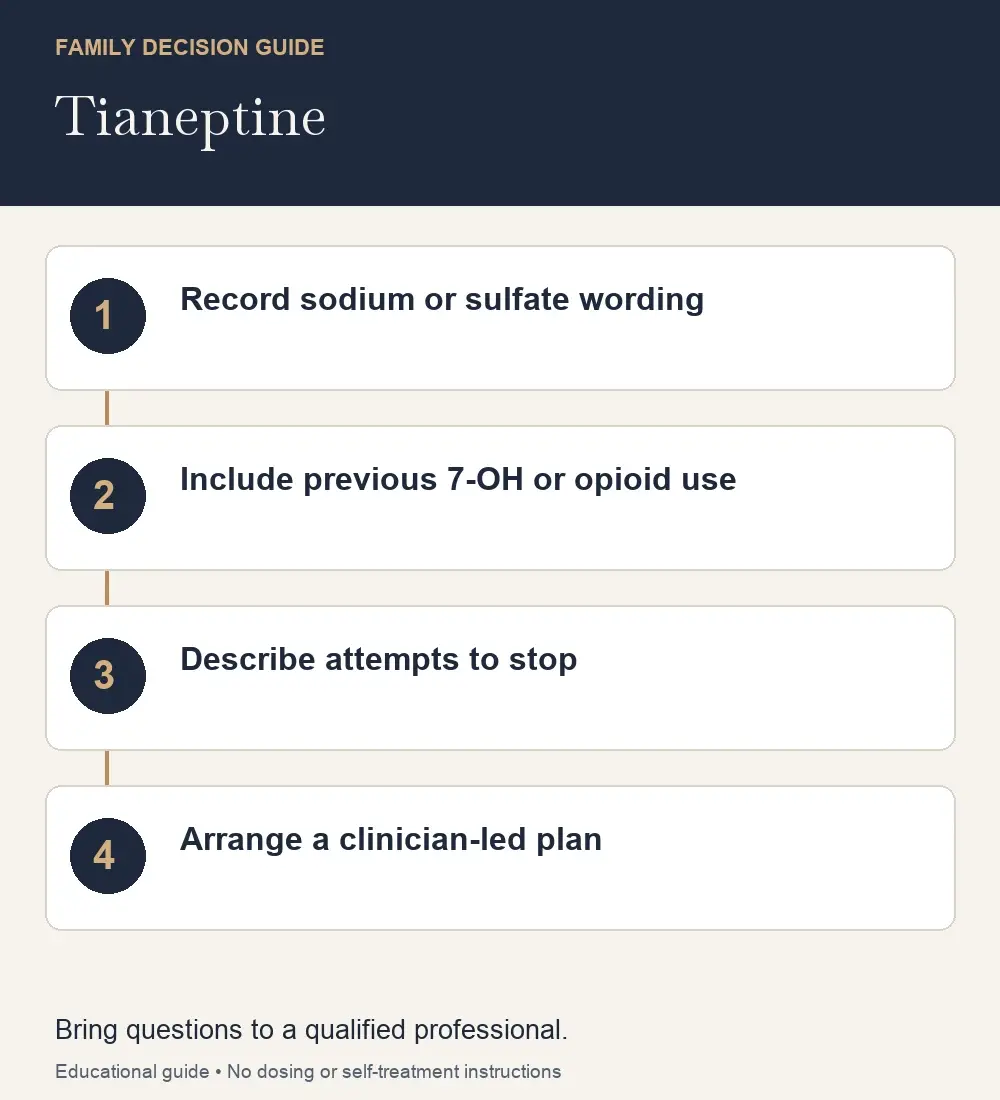
If your loved one has changed forms, record the labels and timing accurately. Tell the clinician why the change was made and what the person reports since then. Do not assume that symptoms after a switch prove the new form is weaker, stronger, or contaminated; assessment should consider more than one explanation.
Why tianeptine is discussed alongside 7-OH
Both names can appear in conversations about products obtained outside conventional medical care. That retail overlap does not make them the same substance. A family should preserve the distinction when describing what has been taken rather than using the catch-all phrase gas station drug.
The FDA notes that some people use tianeptine as an opioid alternative or to self-treat other conditions, and that misuse and withdrawal can resemble opioid-related toxicity and withdrawal (FDA, 2025b). Those concerns are reasons for medical evaluation, not a basis for relatives to select a substitute.
If your loved one says tianeptine will let them quit 7-OH privately, ask what makes professional care feel difficult. Cost, embarrassment, previous experiences, and work obligations may be barriers the family can help address. Buying another product does not resolve those barriers.
| Question | Sodium-labeled product | Sulfate-labeled product |
|---|---|---|
| What does the word identify? | A stated salt form | A stated salt form |
| Does the word verify the entire packet? | No | No |
| Does it supply a clinical withdrawal plan? | No | No |
The information a spouse often sees first
A spouse may notice repeated small purchases, an urgency to replenish capsules, or plans that change when supplies run low. These observations can be important, but they do not establish the exact ingredient or a diagnosis. Ask about the pattern directly and calmly.
Try: “You have said you cannot get through work without this, and the cost is affecting our bills. I want us to speak with someone who can assess what is happening.” That statement connects health and household concerns without demanding that the person agree with a label such as addiction before getting help.
Keep financial boundaries practical. You can offer to help pay an agreed provider directly while declining to fund another purchase. Avoid threats that depend on monitoring every transaction. If shared responsibilities are affected, discuss reliable arrangements for transport, childcare, and bills separately from a debate about product chemistry.
Parents of teens and adult children should ask different follow-up questions
With a teen, ask whether a friend supplied the product, whether anyone else used it, and what the teen understood it to be. Keep the immediate conversation focused on safety. An adolescent-qualified clinician can help assess both the exposure and the reasons for using it.
With an adult child, ask what assistance they would accept. They may want a ride or help finding an appointment without wanting a parent in the examination room. Respect that distinction while staying clear about what support you can provide consistently.
For either age group, avoid using siblings as investigators or monitors. A family health concern should not become a competition to discover hidden purchases. If communication has broken down, professional guidance can help organize a conversation that is direct without becoming punitive or humiliating.
What if they are using tianeptine to avoid withdrawal?
Take the report seriously and arrange medical advice. A person who is using primarily to avoid feeling unwell may be frightened that treatment will mean being left to endure symptoms. Ask the provider how assessment and symptom management work instead of promising an easy process.
Do not administer another person's prescriptions, substitute alcohol, or devise a sodium-to-sulfate taper. The combination of uncertain contents, other substances, and health history makes a family-managed plan unreliable. The clinician should know about both current tianeptine and recent 7-OH or other product use.
Before the appointment, ask the person what happened during previous attempts to stop. Their account can help the provider understand the problem. Avoid treating a failed attempt as proof that they do not care; it may identify a specific barrier or need that the next plan should address.
Do not rely on a familiar brand name
FDA alerts have named products in the tianeptine market, but brand lists are not complete ingredient inventories. Formulations and availability can change. The useful record is the actual packet, bottle, or purchase information connected to the concern (FDA, 2025a).
Photograph the full label and lot details if available. If the contents were transferred into another container, tell the clinician. Do not assume a retailer description proves what was in the material consumed, and do not attempt to identify loose powder by color or taste.
A product advertised as a nootropic or research chemical still belongs in the medical history. People sometimes omit products they do not regard as drugs. Encourage an honest account of supplements, medications, alcohol, and other substances so the assessment is not based on a partial list.
When a reaction requires urgent help
Call 911 if the person is unconscious, has serious breathing problems, or is having a seizure. Give naloxone if opioid overdose is suspected and it is available, following its instructions. Tell responders that tianeptine or an unknown retail product may be involved; do not wait for certainty about the salt form.
For other suspected exposures or adverse reactions, call U.S. Poison Control at 1-800-222-1222. Share the timing, symptoms, label, and other known substances. Do not induce vomiting or try to counter the reaction with another product. Follow case-specific medical guidance (FDA, 2025a).
After emergency care, ask for clear follow-up instructions. A family needs to know who is managing continuing care and when the next assessment should happen. Relief that the immediate crisis has passed should not leave everyone without a plan for the next day.
Questions that make a treatment inquiry more useful
When calling a provider, use the name tianeptine and mention the current formulation if known. Ask whether the service can evaluate emerging-substance use and whether it accepts the person's age group. A program's general addiction description does not answer every eligibility question.
Ask what information is needed before the visit, how medication questions are handled, and what happens if a different level of care is recommended. For an adult, clarify consent for family involvement. For a teen, ask how the clinician explains privacy and guardian participation.
Discuss practical barriers before they prevent attendance. Arrange transportation, childcare, and a way to handle necessary work or school communication. These are concrete contributions a family can make without assuming responsibility for clinical treatment.
Keep the longer-term goal visible
A person can stop one product and still need help with the symptoms, routines, or relationships that led to use. Follow-up should address those needs rather than treating an empty bottle as the sole measure of progress. Ask the care team how family participation can support the plan.
ClearRoute helps families coordinate treatment placement, case management, and family coaching. It does not provide medical detox or prescribe medication. If tianeptine sodium or sulfate has become the next product in a difficult cycle, request a free consultation about a family response connected to appropriate clinical care.
Frequently asked questions
Is tianeptine sulfate a proven safer alternative to sodium?
The salt name alone cannot establish comparative safety for a consumer product or a particular person. Do not use it as a household dosing guide.
Is tianeptine a type of kratom?
No. It is a different drug, although it may be discussed in the same retail-product or opioid-substitution context.
What if my child says it is a medication in another country?
That does not establish that an online or retail product is equivalent to supervised medical use. Seek assessment based on the actual product and circumstances.
Can families help before a loved one accepts an addiction label?
Yes. Begin with symptoms, difficulty stopping, and practical concerns. An assessment does not require the family to diagnose the person first.
References
Centers for Disease Control and Prevention. (2025, June 11). Lifesaving naloxone. https://www.cdc.gov/stop-overdose/caring/naloxone.html
U.S. Food and Drug Administration. (2025a, May 8). FDA warns consumers not to purchase or use any tianeptine product due to serious risks. https://www.fda.gov/drugs/drug-alerts-and-statements/fda-warns-consumers-not-purchase-or-use-any-tianeptine-product-due-serious-risks
U.S. Food and Drug Administration. (2025b, May 9). Tianeptine products linked to serious harm, overdoses, death. https://www.fda.gov/consumers/consumer-updates/tianeptine-products-linked-serious-harm-overdoses-death
Written by John Ingham. Sources and links checked November 9, 2026. Educational information; individual assessment belongs with qualified healthcare professionals.
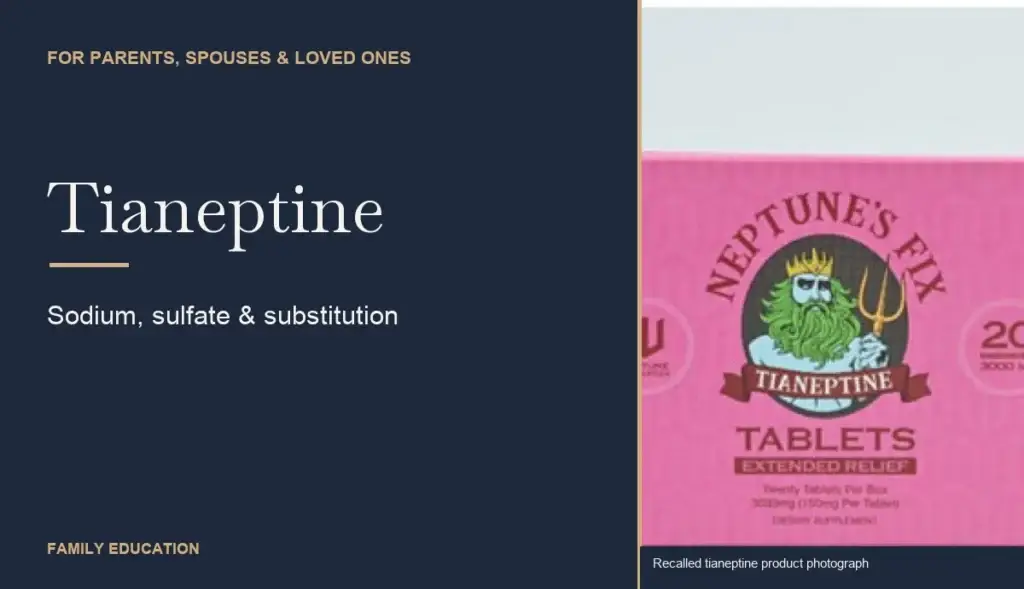
Featured image: recalled Neptune’s Fix product photograph supplied in an FDA recall notice. It illustrates tianeptine product context, not verification of a sodium or sulfate formulation.