
Key takeaways
- SR-17018 is an experimental opioid-receptor compound, not a kratom alkaloid.
- Mouse-study outcomes do not establish a personalized human treatment plan.
- Related SR-series names should not be treated as interchangeable.
- Support the goal of change while seeking qualified medical care.
| Topic | What families should know |
|---|---|
| Also called | SR-17 |
| Evidence discussed | Preclinical opioid research |
| Claim to scrutinize | A guaranteed tolerance reset or home withdrawal protocol |
| Family role | Help access care; do not supervise a research-chemical experiment |
A loved one says they have found a research compound that will reset opioid tolerance or help them leave 7-OH behind. They show you a study, a forum discussion, and a product called SR-17018 or SR-17. The plan sounds technical enough that you may feel unqualified to question it.
You do not need advanced pharmacology training to ask whether a study supports the proposed use in a person. SR-17018 has been investigated in opioid research, but an experimental finding is not a ready-made home treatment. This guide helps families examine the claims without dismissing the fear or discomfort that may be driving the search.
What is SR-17018?
SR-17018 is an experimental compound studied for activity at the mu-opioid receptor. It is distinct from kratom alkaloids such as mitragynine and 7-OH. Its research history includes attempts to understand whether certain receptor-signaling patterns could separate desired effects from unwanted ones.
A 2021 study compared SR-17018 with morphine and oxycodone in mouse pain models. Findings varied by the test used, including tolerance in one assay. That is a reason to read a research claim carefully rather than reduce it to “this compound does not cause tolerance” (Pantouli et al., 2021).
For a family, the essential distinction is between a compound being studied and a product being established for clinical use. A scientific name, a citation, or research-grade packaging does not make an online purchase equivalent to a prescribed medication.
What a “tolerance reset” claim leaves out
A headline or social-media summary may describe a result in animals without explaining the conditions. The species, dose, route, duration, and measured outcome all affect what the experiment can show. A result about a mouse pain response does not establish a safe plan for a person stopping 7-OH.
Ask your loved one to show the actual study rather than an image of its title. Look together for who or what was studied and whether the experiment tested the product they bought. This approach respects their effort to research while making the limits visible.
Avoid replacing one oversimplification with another. You do not need to say the research is worthless. The accurate point is that the evidence does not justify treating an online protocol as a personalized medical plan. A qualified clinician should assess the person's symptoms, history, and options.
Why a research chemical is different from treatment
Treatment involves more than exposure to a compound. It includes an assessment, a known plan, monitoring, a way to respond to problems, and follow-up. A retail purchase does not provide those elements simply because the seller uses scientific language.
The family should ask who will manage a reaction, how the product identity is established, and what happens if the person feels worse. If the answers rely entirely on anonymous posts, the plan has significant practical gaps. Relatives should not agree to fill those gaps by becoming the overnight monitor or informal prescriber.
Do not compare research-chemical purchasing with clinician-managed medication treatment as though both were simply replacing one substance with another. Medical care includes responsibilities and safeguards that a household cannot reproduce. The decision should be about obtaining appropriate care, not proving that all medication is bad.
| Evidence type | What it can contribute | What it cannot establish alone |
|---|---|---|
| Cell experiment | Receptor or signaling information | A safe human use plan |
| Animal study | Effects under specified conditions | Reliable outcomes for your loved one |
| Personal report | An individual’s account | Controlled evidence of effectiveness |
Understanding why your loved one is interested
People may search for SR-17018 because they are afraid of withdrawal, have had an unsatisfactory treatment experience, or worry that seeking care will disrupt work or family life. Ask which of those concerns applies instead of assuming the only motive is intoxication.
A useful opening is: “I understand you are trying to get out of a difficult situation. I am worried about using a research product without someone qualified to manage it.” This acknowledges the goal while questioning the method. It also gives the person room to explain what they need.
Listen for a specific barrier you can help address. That might be transportation, cost questions, childcare, or finding a provider who understands the products involved. A practical offer can be more useful than forwarding another alarming article after the person has stopped listening.
A study checklist for families
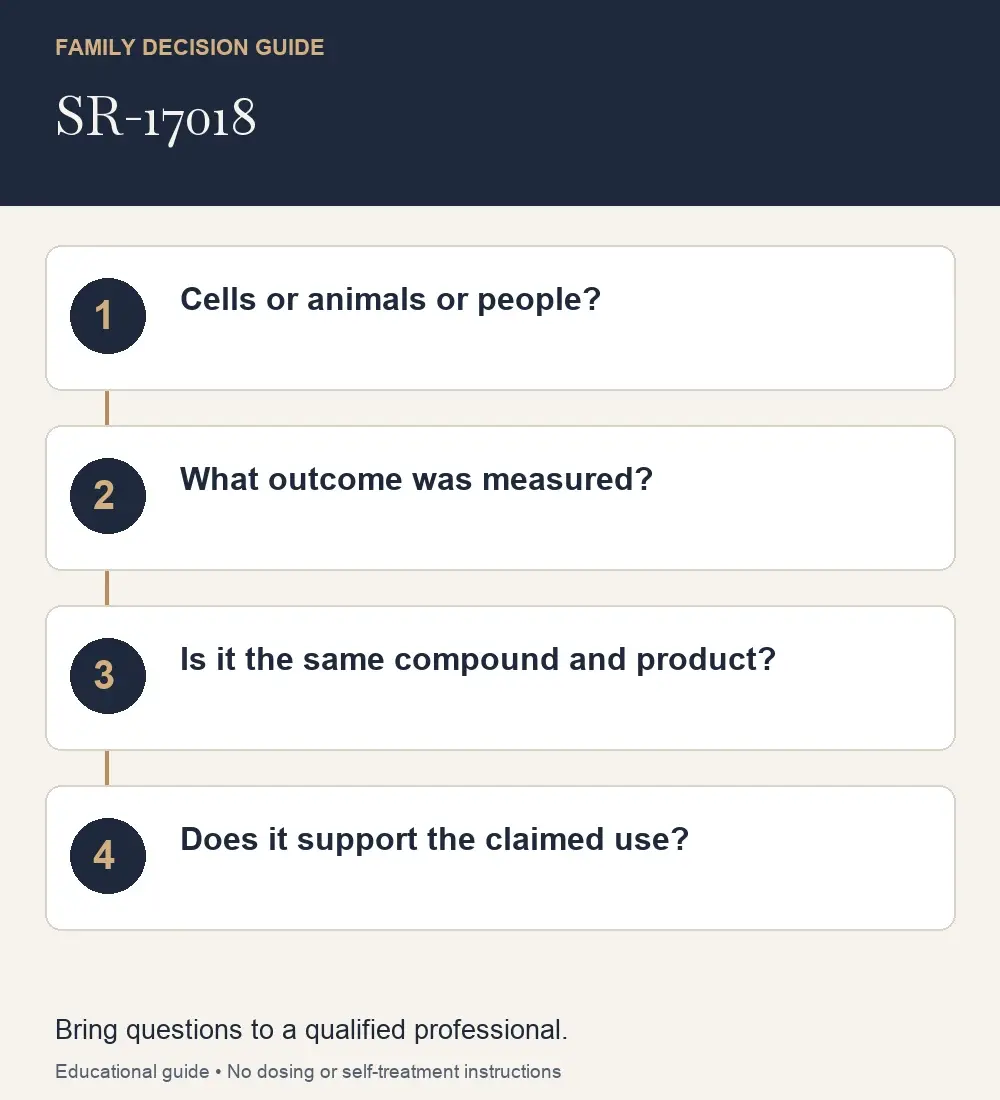
Start with the study population. Was it conducted in cells, animals, or people? Then look at what was measured. A change in a laboratory signal is different from demonstrated improvement in health, daily functioning, or long-term recovery.
Next, ask whether the study concerns the same compound and formulation. Related SR-series names are not automatically interchangeable. A product labeled SR-17 should not be treated as equivalent to another numbered research compound because an online discussion groups them together.
Finally, distinguish observation from a controlled trial. Personal reports can identify questions worth studying, but they cannot establish how another person will respond. A family should not use anecdotes to predict a safe amount, a withdrawal timetable, or the effect of combining products.
What to do if SR-17018 has already been purchased
If nobody has taken it, avoid experimenting and seek professional advice about the concern that led to the purchase. Keep it away from children and pets. Do not open a capsule or taste powder to assess authenticity.
If someone has used it, record the label exactly and ask when it was taken, what else was used, and how they feel. Do not assume the product contains verified SR-17018 merely because the package says so. Tell the clinician which information is confirmed and which comes from the seller or the person's understanding.
Bring the prior 7-OH or opioid history into the assessment. A new product should not erase the context that led to it. Recent changes may be important even if the person believes the old substance is no longer relevant.
Spouses should not become responsible for a home experiment
A partner may be asked to hold capsules, decide when another amount is needed, or watch for symptoms through the night. It can feel hard to refuse when the request is framed as helping someone recover. You can support recovery while declining responsibilities that require clinical expertise.
Offer an alternative role: arrange a medical consultation, help gather records, or organize reliable transport. State the boundary clearly: “I will help you get care, but I cannot manage a research-chemical plan.” A calm, consistent boundary is more useful than agreeing reluctantly and then arguing during a crisis.
If children live in the home, plan dependable caregiving and driving arrangements. Do not ask them to report on an adult's condition. If conflict becomes threatening, prioritize safety and outside support instead of trying to persuade the person in that moment.
Parents of teens and adult children
A teen's interest in a research chemical should lead to an age-appropriate assessment and a direct conversation about what they expected it to do. Ask whether a peer supplied it or whether they bought it to manage symptoms from another product. Do not assume the label tells the whole story.
For an adult child, ask what support they would accept and respect their role in decisions. You can still decline to fund a research purchase and offer help with qualified care. Avoid making emergency assistance conditional on their willingness to follow your advice.
A family consultation can be useful when one parent sees the purchase as a hopeful attempt to quit and another sees it only as a new danger. Both may be responding to real concerns. A coordinated plan can acknowledge the goal while moving away from an unsupported home experiment.
When symptoms require immediate action
Call 911 if the person cannot be awakened, is not breathing normally, or has a seizure. Give available naloxone for suspected opioid overdose according to its instructions and follow dispatcher guidance. Do not wait for certainty about a research product's identity before requesting emergency help.
For other suspected exposure concerns, call U.S. Poison Control at 1-800-222-1222. Provide the package name, timing, and other known substances. Do not give another compound to reverse or balance the effects. General opioid emergency guidance applies to the response to suspected overdose, not to a claim that every SR-labeled product has verified contents (CDC, 2025).
Bring the claim itself to a medical conversation
Show the clinician the study or protocol your loved one relied on. That can help clarify expectations and reveal why they are reluctant to consider another approach. The appointment should address the person's goal as well as the product.
Ask how current symptoms will be managed, what established treatment options may fit, and how follow-up works. If the person has previously felt dismissed, encourage them to say so. A new assessment can focus on what was missing from earlier care rather than treating the previous experience as a reason to abandon medical help.
Help families move from research claims to care
ClearRoute can help organize a family response through crisis intervention, treatment placement, and ongoing case management. It does not prescribe, supervise research-chemical use, or provide medical detox.
If SR-17018 has become part of a loved one's plan to stop 7-OH or other opioids, request a consultation about appropriate next steps. The family can support the desire for change while seeking a plan that includes qualified assessment, clear responsibilities, and continuing care.
Frequently asked questions
Is SR-17018 the same as 7-OH?
No. SR-17018 is a different experimental compound. Its appearance in substitution discussions does not make it a kratom alkaloid.
Do mouse studies prove a tolerance reset in humans?
No. Study population, methods, and outcomes limit what can be concluded. The cited mouse research is not a validated home treatment protocol.
Should a parent supervise an online SR-17 schedule?
No. Offer help accessing a clinician rather than taking responsibility for an unverified research-product plan.
What should a loved one bring to a consultation?
The product label, prior substance history, current symptoms, and the study or protocol they relied on can help clarify both exposure and expectations.
References
Centers for Disease Control and Prevention. (2025, June 11). Lifesaving naloxone. https://www.cdc.gov/stop-overdose/caring/naloxone.html
Pantouli, F., Grim, T. W., Schmid, C. L., Acevedo-Canabal, A., Kennedy, N. M., Cameron, M. D., Bannister, T. D., & Bohn, L. M. (2021). Comparison of morphine, oxycodone and the biased MOR agonist SR-17018 for tolerance and efficacy in mouse models of pain. Neuropharmacology, 185, Article 108439. https://pubmed.ncbi.nlm.nih.gov/33345829/
Written by John Ingham. Sources and links checked November 9, 2026. Educational information; individual assessment belongs with qualified healthcare professionals.