
Key points
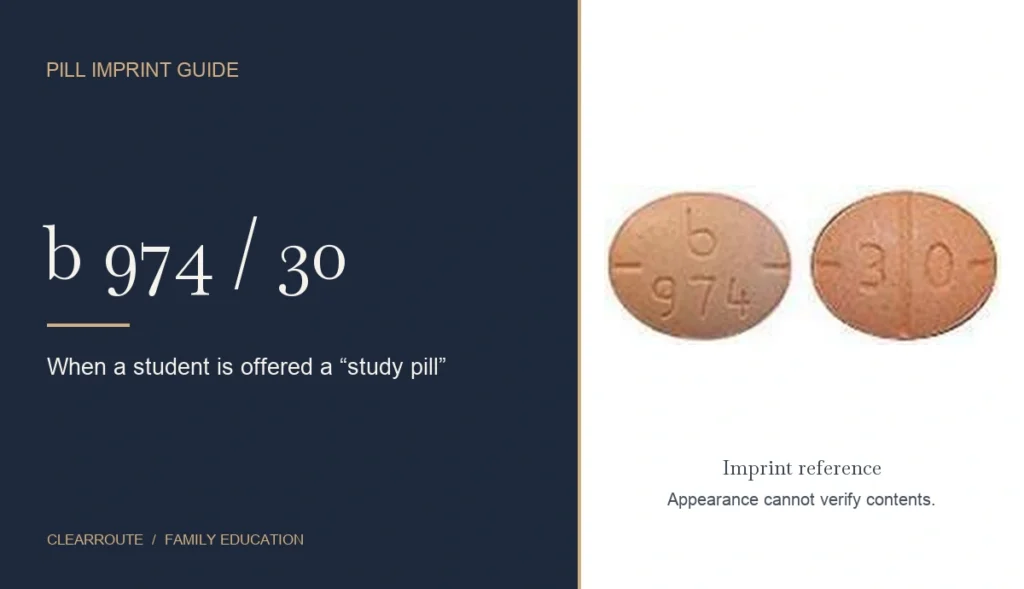
- A peach, oval tablet with b over 974 on one side and 30 on the other matches a documented immediate-release mixed amphetamine salts product.
- DEA laboratories have tested counterfeit tablets copying this marking. Methamphetamine was found in seized examples; a familiar imprint does not verify a tablet sold as Adderall.
- Students who borrow pills for exams and students who take prescribed ADHD medication need different conversations. Neither can be assessed from a photograph alone.
A college student comes home after finals with a peach tablet tucked into a laptop sleeve. They call it “a study pill” and say it came from a classmate with ADHD. Their parent’s first concern might be whether they cheated on an exam or have been hiding a diagnosis. A more useful opening is, “Did you take one, and how are you feeling now?” If someone may have swallowed an unknown pill, get exposure advice before deciding how to address school or household rules.
What the b 974 / 30 marking means
The label for one mixed amphetamine salts product describes a peach oval tablet marked with a lowercase b above 974 on one face and 30 on the opposite face. The documented strength is 30 mg. These are stimulant ingredients used in prescription medications, including for ADHD. The name Adderall is often used conversationally for products in this family; the imprint does not prove which manufacturer supplied a loose pill. (National Library of Medicine, n.d.)
The marking is best read as two observations. Record what is on each face rather than treating 97430 as a single code. If part of the tablet is missing, describe only what is visible. Do not break it further to see what is inside. A pharmacist reviewing a legitimate prescription can check whether the dispensed product’s appearance matches the record.
A copied stimulant imprint does not predict stimulant contents
The DEA report documents counterfeit b 974 / 30 tablets among U.S. seizures. In tested examples, methamphetamine was frequently identified, and other substances, including fentanyl, appeared in some samples. That does not mean every pill bearing the mark contains those drugs. Nor does the absence of a particular symptom clear an unknown pill. (U.S. Drug Enforcement Administration, 2026)
Imagine two classmates received tablets from the same person. One reports being awake all night; the other says they felt very little. Neither experience tells the family what was in the remaining tablets. Do not use another person’s reaction or a familiarity with prescription stimulants as a safety test.
What can go wrong with the real medication?
Prescription stimulants have legitimate medical uses. A clinician considers symptoms, health history, other medicines, and follow-up when prescribing them. Sharing that prescription removes those safeguards. FDA warns that misuse can lead to addiction, overdose, and death. The warning is a reason for careful prescribing, storage, and follow-up, not a reason to shame someone receiving ADHD treatment. (U.S. Food and Drug Administration, 2023)
A student may take a borrowed tablet because they are behind on assignments, sleeping poorly, or struggling to concentrate. Those problems deserve attention, but a pill obtained from a classmate is not an ADHD evaluation. Feeling more awake or focused after a stimulant does not diagnose ADHD. Arrange an appointment that addresses concentration, sleep, anxiety, workload, and substance use together.
How to handle an urgent call from campus
Ask where the student is and whether someone can stay with them. If there is chest pain, a seizure, collapse, severe distress, breathing trouble, or inability to wake them, get emergency help. Do not assume a person who expected a stimulant cannot be experiencing an opioid overdose. Describe it as “a pill sold as Adderall,” not confirmed amphetamine. (U.S. Food and Drug Administration, 2023) (Centers for Disease Control and Prevention, 2024)
For a possible ingestion without emergency signs, call Poison Control, even if the student feels well. Useful information includes when the tablet was taken, whether alcohol or other substances were used, and any prescribed medications. If the student does not know the answer, say that. Do not send them to drive themselves or wait for a roommate to locate the seller before calling. (National Capital Poison Center, n.d.)
A better conversation than “Why would you do that?”
Ask what problem they were trying to solve. “Were you worried about staying awake, finishing a paper, fitting in, or something else?” The answer can lead to a practical plan. If they were overwhelmed, help them identify a campus health appointment and one academic support contact. If taking pills is becoming routine, ask for a substance-use assessment as well.
Parents sometimes want a promise that their student will never use anything again. A more workable first agreement is specific: they will attend an appointment, avoid accepting pills outside a prescription, and contact a trusted person if someone becomes ill. Set a time to follow up after the appointment rather than checking in only when another crisis occurs.
If your student has an ADHD prescription
Do not interpret a prescription as evidence of misuse. Instead ask whether someone has pressured them to share or sell medication. Students may need a simple refusal they can use without discussing their diagnosis: “I don’t share prescription medicine.” A secure place for their own medication can reduce pressure from roommates and visitors. (U.S. Food and Drug Administration, 2023)
If pills are missing or the student has taken more than prescribed, encourage an honest call to the prescriber. Do not tell them to change their dose or use a friend’s supply to cover a gap. Ask the clinician what a safe plan looks like during exams, travel, or a break between semesters.
Where ClearRoute fits
Family coaching can help parents raise concerns without turning every academic difficulty into an accusation. ClearRoute’s executive functioning and ADHD coaching can support organization and routines; it does not diagnose ADHD, prescribe stimulants, or replace an assessment for substance use. Contact ClearRoute for help planning those conversations after immediate medical concerns have been addressed.
When the student is 16 versus 22
A high-school student and an adult college student can face the same pressure to share study pills, but parents have different roles in follow-up. With a teen, arrange an age-appropriate assessment and ask the clinician how to support the treatment plan. With an adult child, offer to find appointments, arrange transportation, or join a call if invited. ClearRoute works with parents of teens and adult children; no student needs an ADHD diagnosis for a parent to ask for family support.
Frequently asked questions
Does b 974 mean the pill is extended release?
The cited labeled product is an immediate-release tablet. That information does not verify the formulation of a loose pill. Check a prescribed medication against the pharmacy label rather than assuming its release pattern.
Is methamphetamine the same thing as the labeled medication?
No. The legitimate match is mixed amphetamine salts. DEA identified methamphetamine in counterfeit examples bearing this pattern. A parent cannot distinguish them by sight.
Does borrowing a pill suggest my student has ADHD?
No. Concentration problems have several possible explanations, and a response to a stimulant is not diagnostic. A qualified clinician can assess the student’s symptoms and needs.
What if the student got it from a friend with a prescription?
The friend’s prescription does not extend to another person. It also does not verify where this particular tablet came from. Treat a possible exposure as a health question, not a question of whether the friend seems trustworthy.
Should we report the student to the school before seeking help?
Medical safety comes first. Arrange urgent advice if an exposure may have occurred. Campus rules and academic concerns can be addressed separately when everyone is safe.
Sources
Centers for Disease Control and Prevention. (2024, April 2). What to do if you think someone is overdosing. https://www.cdc.gov/stop-overdose/response/
National Capital Poison Center. (n.d.). First aid guidelines. https://www.poison.org/first-aid-for-poisonings
National Library of Medicine. (n.d.). Mixed amphetamine salts tablets [Drug label]. https://dailymed.nlm.nih.gov/dailymed/drugInfo.cfm?setid=cffbbb15-d776-41ae-a8a6-687f2c07bfa4
U.S. Drug Enforcement Administration. (2026). Counterfeit pills seized in the United States between January 1, 2024 and December 31, 2025. https://www.dea.gov/sites/default/files/2026-10/US-2024-2025%20Counterfeit%20Pill%20Data.pdf
U.S. Food and Drug Administration. (2023, May 11). FDA updating warnings to improve safe use of prescription stimulants used to treat ADHD and other conditions. https://www.fda.gov/drugs/drug-safety-communications/fda-updating-warnings-improve-safe-use-prescription-stimulants-used-treat-adhd-and-other-conditions
Featured photograph: DEA imprint reference, p. 5. The reference image does not authenticate a found tablet.