
Key points
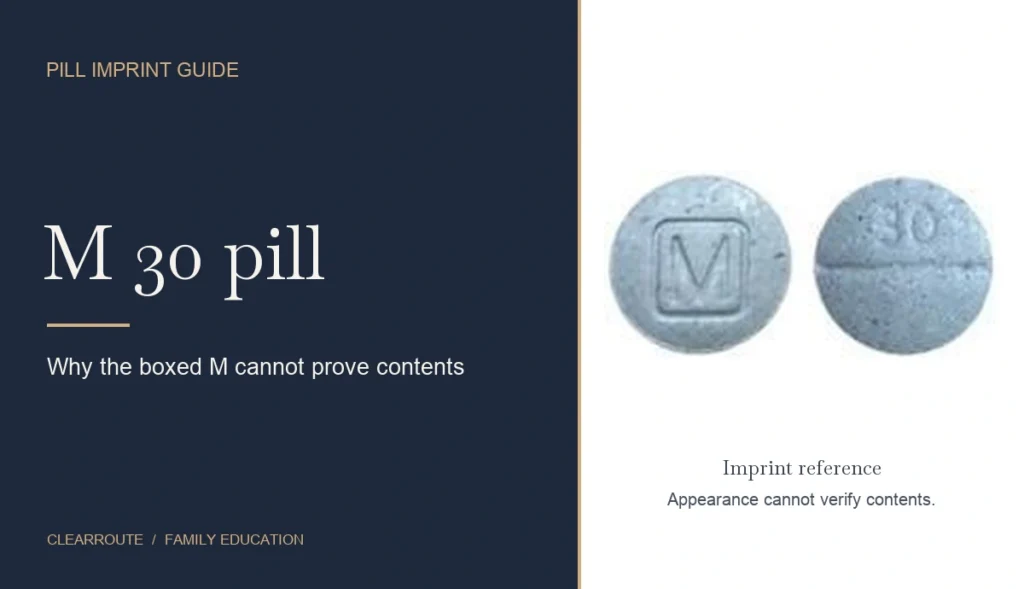
- A boxed M on one face and 30 above a score on the other match a documented light blue, round oxycodone hydrochloride 30 mg tablet. They also appear on counterfeit pills.
- M / 30 was the most prevalent counterfeit imprint type among pills in DEA’s national seizure report. That finding describes a selected law-enforcement sample, not every blue pill or pharmacy prescription.
- If someone may have taken a “blue,” report it as an unknown pill. Do not wait for visual confirmation before seeking help.
A younger brother calls from a party and says his friend took “a blue.” He has a photo of a round tablet with an M, but he cannot tell you how the friend is breathing. Ask him to check the person and get help where they are. The photo can wait. A nickname does not tell an emergency dispatcher whether the person is awake, breathing normally, or in immediate danger.
What does the boxed M / 30 imprint match?
A prescription label describes a light blue, round oxycodone hydrochloride tablet with a boxed M on one side and 30 above a score line on the reverse. The legitimate labeled strength is 30 mg. People often write the imprint as M30 or M 30 even though the two marks are on opposite faces. A single letter M, a lone 30, or blue coloring alone is a much less specific description. (National Library of Medicine, n.d.)
Oxycodone is an opioid pain medicine. The referenced tablet is not a combination with acetaminophen. Families may hear “Perc,” “oxy,” and “blue” used as if they were interchangeable; none is a reliable statement of ingredients. Tell medical staff the words the person used and, separately, what someone actually saw. Avoid converting street shorthand into a confident drug name.
Why there is so much concern about counterfeit M30 pills
In its report on pills seized during 2024–2025, DEA describes the M / 30 pattern as the most prevalent pill type submitted to its laboratories in this counterfeit-pill series. Fentanyl and other ingredients were identified in analyzed examples. That is direct evidence of imitation, not an estimate of the probability that a pill in a particular household contains fentanyl. (U.S. Drug Enforcement Administration, 2026)
There is a difference between “the DEA found fentanyl in tablets with this marking” and “this tablet contains fentanyl.” The first statement is supported by laboratory work. The second would require evidence about the specific object. Families do not need the second statement to take an exposure seriously.
Do not use a list of alleged printing errors to decide which tablet is safe. A sharp imprint, smooth edge, or familiar shade can be copied. Conversely, differences in lighting and camera quality can make legitimate tablets look different in photographs. A visual comparison is useful for communication, not chemical analysis.
The prescription risk does not disappear if the pill is real
A prescribed opioid can slow or stop breathing, especially when taken by someone it was not prescribed for or combined with alcohol or sedating drugs. It can also lead to misuse and addiction. A clinician evaluates these risks against the patient’s need for pain treatment. A friend handing over a pill cannot make that evaluation. (National Library of Medicine, n.d.)
If someone says the pill came from their own pharmacy but looks different from a previous refill, contact the dispensing pharmacist. Ask them to check the manufacturer and description associated with that fill. Do not take the questionable tablet while waiting for clarification. If it has already been swallowed and the identity is uncertain, call Poison Control rather than waiting for the pharmacy to reopen.
What a sibling or roommate can do at the scene
Tell the dispatcher the exact location first. “We are at the north entrance of this building” is more useful than “I think it was an M30.” Then describe the person: Are they responding to their name? Are they breathing normally? Did anyone see them take a pill, or was a tablet merely found nearby? Stay with them and follow the dispatcher’s instructions.
If an opioid overdose is suspected, use available naloxone as directed and call 911. A person who wakes after naloxone still needs emergency evaluation. Do not leave them alone because they ask you not to tell anyone. Avoid debating who supplied the tablet while responders are on the way. (Centers for Disease Control and Prevention, 2024)
If your sibling is calling you from another location, encourage the person on scene to call 911 directly. If they cannot, give emergency services the location where help is needed. Do not spend the call forwarding photographs to relatives in the hope that someone recognizes the pill.
After everyone is safe: ask what the person believed
A useful first question is, “What did you think you were taking?” Follow with, “Was it dispensed to you, or did someone give it to you?” Those questions make room for the possibility that your loved one was misled. They also make it easier to discuss pain, anxiety, or withdrawal without arguing over a nickname.
A sibling can offer to sit with someone while they call a clinician or help them get a ride. That does not require taking responsibility for all future decisions. Be explicit about one boundary you can keep: “If you’re hard to wake again, I’m calling for help, even if you asked me not to.” Clear expectations are easier to remember in a frightening situation than a general promise to be careful.
What families should plan before the next weekend
Make sure household members know where naloxone is kept, how to follow its instructions, and how to describe their location to responders. Ask a pharmacist about obtaining it and replacing an expired device. Naloxone is for a suspected opioid overdose; it does not identify a tablet or treat every possible substance. (Centers for Disease Control and Prevention, 2024)
If use is recurring, arrange an assessment rather than relying on better supervision at parties. Ask whether pain, physical dependence, mental health symptoms, or other substance use needs attention. ClearRoute family coaching can help siblings and parents agree on a response. Treatment placement support can help navigate clinically appropriate options. For planning outside an emergency, request a consultation.
A parent’s role after the emergency
If the person who took a pill is your teen, arrange follow-up with a pediatric or adolescent provider and make a plan for how they can call you from a party. If they are your adult child, ask what support they want at the next appointment and what you can do about transportation or other barriers. ClearRoute helps parents of both teens and adults prepare intervention conversations. A parent may seek coaching about their own response even before an adult child chooses to participate.
Frequently asked questions
Is every blue M30 pill fentanyl?
No. There is a documented prescription oxycodone product and there are documented counterfeit lookalikes. The appearance cannot tell you which ingredients a particular tablet contains.
Is M30 the same as a 30 mg Percocet?
The referenced M / 30 label describes oxycodone alone. Percocet is a combination product with oxycodone and acetaminophen. Informal names do not establish that either description fits a found pill.
What if the tablet is a different color?
Report its actual color and markings without trying to force a match. A mismatch does not prove a particular ingredient, and a match does not prove authenticity.
Should I post a photo online to identify it?
A pharmacist can advise on a legitimate medication question. Public replies cannot verify contents and may expose private information about your loved one. If someone may have taken it, seek poison advice first.
Does finding an M30 mean my sibling has an opioid use disorder?
No. It establishes a safety concern, not a diagnosis. Ask about exposure and source, and seek a professional assessment if there are repeated incidents or difficulty controlling use.
Sources
Centers for Disease Control and Prevention. (2024, April 2). What to do if you think someone is overdosing. https://www.cdc.gov/stop-overdose/response/
National Capital Poison Center. (n.d.). First aid guidelines. https://www.poison.org/first-aid-for-poisonings
National Library of Medicine. (n.d.). Oxycodone hydrochloride tablets [Drug label]. https://dailymed.nlm.nih.gov/dailymed/drugInfo.cfm?setid=928227bf-89c5-4c64-9823-0e84cc669388
U.S. Drug Enforcement Administration. (2026). Counterfeit pills seized in the United States between January 1, 2024 and December 31, 2025. https://www.dea.gov/sites/default/files/2026-10/US-2024-2025%20Counterfeit%20Pill%20Data.pdf
Featured photograph: DEA imprint reference, p. 4. The reference image does not authenticate a found tablet.