
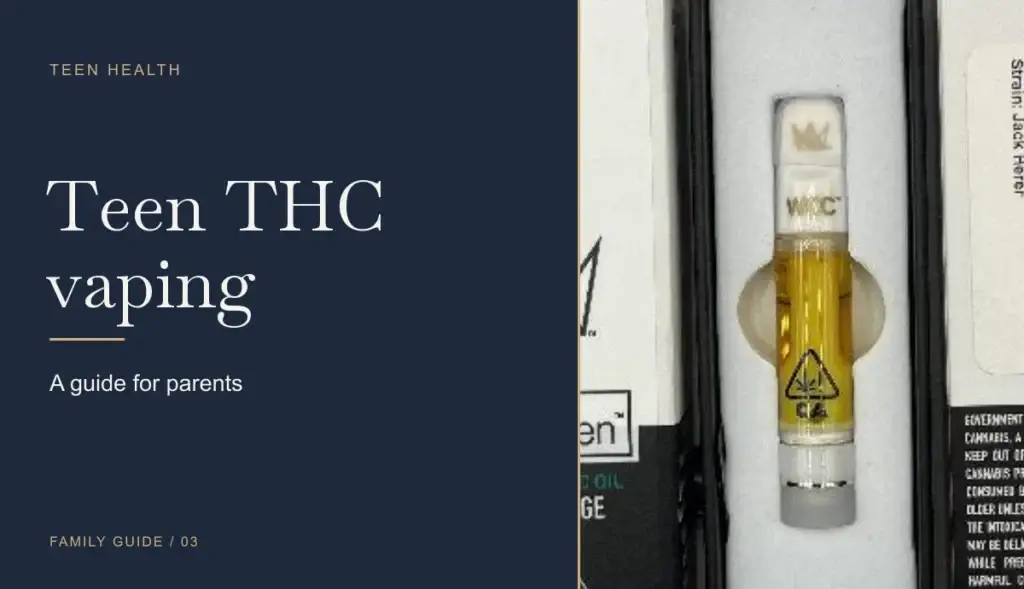
Key points
- A vape’s shape or smell cannot reliably tell you its contents.
- THC can affect attention, memory, coordination, and mental health; frequent use deserves professional attention.
- A calm conversation and an adolescent health assessment are more useful than trying to diagnose a teen from a device.
A small device in a backpack can raise large questions. You may not know whether it contains nicotine, THC, or something else. Your teenager may insist it belongs to a friend or that everyone uses one. You do not have to decide which explanation is true before addressing safety and setting a time to talk.
Start with what you know. You found a device, or you have noticed changes that concern you. Neither proves a specific substance or diagnosis. Keeping that distinction clear makes it easier to ask direct questions without turning uncertainty into an accusation.
What THC vaping means
THC is the main intoxicating component of cannabis. Vaping can involve cannabis oils or concentrates rather than dried plant material. Products differ, and the appearance of a cartridge does not establish the amount of THC or whether other substances are present. Vaping is not a guarantee of safety (Centers for Disease Control and Prevention [CDC], n.d.).
Do not taste the liquid or try the device to identify it. If there is packaging, keep it available for a healthcare professional. Record the words on the label rather than relying on slang. “Cart,” “pen,” and “disposable” describe formats, not a verified ingredient list.
Why adolescence changes the discussion
Adolescence is a period of continued brain development. Cannabis can affect learning, attention, memory, and coordination. Earlier and more frequent use is associated with greater concern, but no parent can predict an individual teenager’s future from one incident (CDC, 2024).
Make the discussion about current functioning as well as long-term risk. Is your teen struggling to get to school, finish assignments, sleep consistently, or enjoy activities without using? Those are useful questions for an assessment. Avoid statements that their brain is permanently ruined; frightening certainty is not a substitute for evidence or a path to care.
Notice patterns without treating them as proof
Late assignments, irritability, red eyes, or a changed sleep schedule can have multiple explanations. Depression, anxiety, a sleep problem, ordinary stress, and substance use may overlap. The aim is to understand the pattern rather than identify one behavior that “proves” THC use.
Keep observations brief and specific. A note that your teen missed first period three times is useful. A file of every disagreement may make the home feel like an investigation. Explain that you want to understand what is getting harder and whether substances are part of it.
Ask about frequency, setting, and purpose in everyday language: “Is it something you use with friends, or are you using it to get through the day?” “What do you notice when you do not use it?” A teenager who says they use THC to sleep or manage anxiety needs those concerns taken seriously, not dismissed as excuses.
How to talk after finding a vape
Choose a calm moment and state the household expectation clearly. You can be firm about not using THC while also listening. “I am not okay with this, and I want to understand what is happening” is more constructive than demanding a confession before any help is offered.
Give your teen time to answer. Ask one question at a time and resist filling every silence. If the conversation escalates, set a specific time to return to it. Do not postpone urgent medical attention while waiting for an honest account.
Discuss practical safety: no driving or riding with an impaired driver, no sharing unknown products, and contacting a trusted adult if someone becomes unwell. Make clear that getting help comes before punishment during an emergency. That does not remove household rules; it removes uncertainty about whether they should call.
When symptoms need urgent attention
Severe confusion, hallucinations, chest pain, breathing difficulty, a seizure, or inability to wake someone needs urgent medical assessment. Call 911 for an emergency and explain what may have been used. Do not assume every symptom after vaping is caused only by THC.
For a suspected exposure without an immediate emergency, contact U.S. Poison Control at 1-800-222-1222. Keep the device or packaging available if safe, and follow professional instructions. A teenager who seems frightened or unusually suspicious should not be left alone to drive or handle the situation (CDC, n.d.).
What a professional assessment can clarify
Arrange an appointment with a pediatrician, adolescent medicine clinician, or qualified behavioral health provider. Ask how they assess substance use alongside sleep, mood, attention, and other health concerns. Explain the changes you have observed and let your teen describe their own experience.
A provider may speak with your teen privately for part of the appointment. Ask in advance how confidentiality, safety concerns, and parent participation are handled. Private time can support honest care; it does not mean the family has no role. Request a clear plan for what happens after the visit.
Home testing should not become the entire strategy. Discuss what a test can and cannot answer with the clinician, including timing and interpretation. A result does not by itself explain impairment, establish a complete diagnosis, or tell you why your teen is using.
When use becomes difficult to stop
Repeated unsuccessful efforts to stop, use despite problems, or giving up important activities can indicate a need for a fuller evaluation. Cannabis use disorder is a clinical condition, not a judgment about character. A professional can assess severity and appropriate support (CDC, n.d.).
Families can help by making attendance and follow-up possible. Ask about school schedules, transportation, family sessions, and what to do if symptoms worsen. Keep expectations concrete: attending an appointment, following an agreed safety plan, and discussing difficulties early.
Rebuilding routines without constant conflict
Choose a few priorities rather than redesigning your teen’s entire life overnight. A predictable sleep routine, a plan for school attendance, and one regular family check-in may be easier to sustain than a long list of restrictions. Connect expectations to safety and functioning, and review them with the treating professional.
Avoid turning siblings into monitors. Do not ask them to search belongings or report every interaction. They can know how to get an adult in an emergency without becoming responsible for another child’s recovery. Parents also benefit from support so each conversation does not depend on how exhausted or frightened they feel that day.
Family support through ClearRoute
ClearRoute’s family coaching and education helps parents organize concerns, prepare conversations, and establish workable boundaries. When clinical care is needed, treatment placement support can help explore appropriate options and provider availability.
A teen’s care needs an age-appropriate clinical assessment. ClearRoute does not replace pediatric or emergency care. Request a consultation to discuss support for your family and the questions you want to bring to the next appointment.
When a parent is worried about an adult child who vapes THC
The adolescent health guidance in this article applies to teens. A parent who finds a similar device in an adult child’s car can still ask what was used and whether anyone needs help. Offer a visit with their own clinician and let them decide whether you participate. ClearRoute supports parents of teens and adult children with conversations, intervention planning, and appropriate referrals.
Frequently asked questions
Can I tell whether a vape contains THC or nicotine?
Not reliably from its appearance. Packaging may provide clues but cannot verify contents. Do not taste or use an unknown device to identify it.
Does one incident mean my teen needs residential treatment?
No. The appropriate response depends on safety, frequency, health, functioning, and a clinical assessment. Care should be individualized.
Is vaping cannabis safer because there is no smoke?
Vaping still has health risks and can involve concentrated THC or unknown ingredients. The absence of smoke does not make it safe for teenagers.
Should I punish my teen before speaking to a professional?
Address immediate safety and communicate clear rules. A professional can help you choose proportionate, consistent responses that support engagement rather than replace assessment.
Can anxiety be part of the reason for use?
Yes, some teens describe using to cope. That explanation should lead to assessment of both the anxiety and substance use rather than assuming one excludes the other.
Sources
Centers for Disease Control and Prevention. (2024, February 15). Cannabis and brain health. https://www.cdc.gov/cannabis/health-effects/brain-health.html
Centers for Disease Control and Prevention. (2024, February 15). Cannabis and teens. https://www.cdc.gov/cannabis/health-effects/cannabis-and-teens.html
Centers for Disease Control and Prevention. (n.d.). Cannabis frequently asked questions. https://www.cdc.gov/cannabis/faq/
Centers for Disease Control and Prevention. (n.d.). Understanding your risk for cannabis use disorder. https://www.cdc.gov/cannabis/health-effects/cannabis-use-disorder.html
Educational information; not a diagnosis or an individualized treatment plan. For an immediate medical emergency, call 911.
Featured photograph: California Department of Cannabis Control, October 2024 recall photograph. Image source.