
Key points
- A pill’s color, shape, or imprint can be a clue, but it cannot prove what an unknown pill contains.
- Check whether anyone may have swallowed it before beginning an online search.
- A pharmacist can help with legitimate medication identification; suspected exposure needs Poison Control or emergency guidance.
Finding a loose tablet can trigger an immediate search for answers. You may want to know the name before speaking with your child, spouse, or parent. That instinct is understandable, but identifying the object is not the only task. First determine whether someone might have taken it and whether anyone is unwell.
A pill can be a misplaced prescription, an over-the-counter medicine, or something obtained outside a pharmacy. Its presence alone does not prove misuse. At the same time, a convincing match to an online photograph does not establish safety. The next step should account for both possibilities.
First, check the person—not the search results
If someone is difficult to wake, breathing abnormally, having a seizure, or showing severe confusion, call 911. Tell the dispatcher that an unknown medication or substance may be involved. Do not wait to identify the pill. If opioid overdose is suspected and naloxone is available, use it as directed and remain with the person while help arrives (Centers for Disease Control and Prevention [CDC], 2025).
If an ingestion may have occurred without those emergency signs, call U.S. Poison Control at 1-800-222-1222 for case-specific advice. Have the person’s age, symptoms, possible timing, and any packaging ready if available. Do not induce vomiting or give home remedies unless directed by a professional.
What to record safely
Keep children and pets away from the item. Avoid crushing, tasting, smelling closely, or handling loose powder. If the intact pill can be documented safely, note the imprint on both sides, its shape, color, and whether there is a score line. Photograph both sides without exposing anyone’s prescription details in a public post.
Look for an original labeled container nearby, but do not assume that every pill in a container belongs there. Keep separate items separate. A photograph of the discovery location may help you remember what was found, but it does not establish who used it.
Write down what you know and what you do not. “One tablet found in a shared bathroom” is accurate. “My teenager is taking this medication” may be an unsupported conclusion. That distinction matters when you speak with a pharmacist or family member.
Why an imprint match is not confirmation
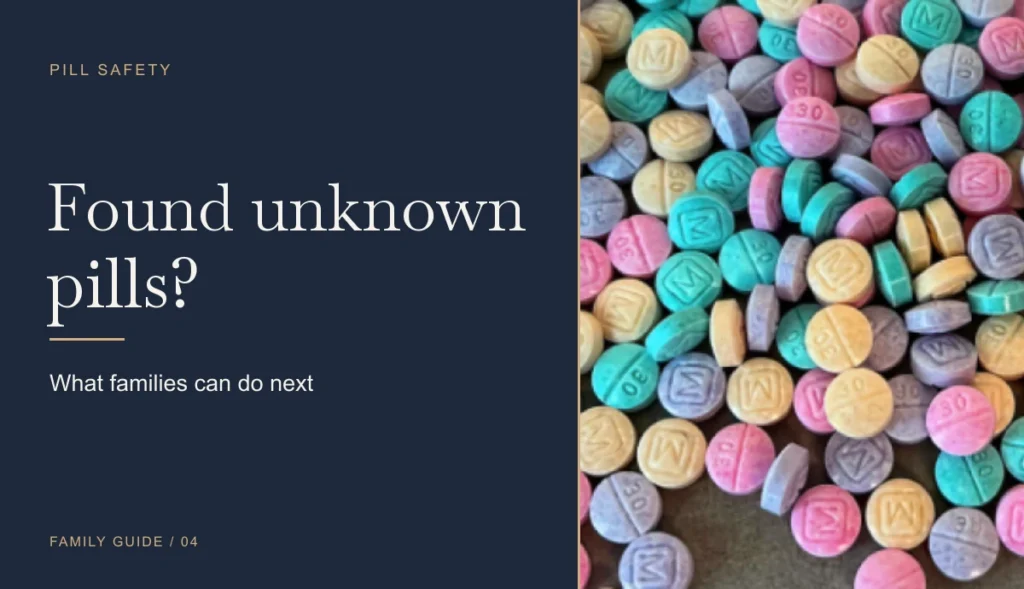
Legitimate medicines use identifying marks, and a pharmacist may be able to compare an intact pill with reliable medication information. Counterfeit tablets can copy those same markings. DEA laboratory work has documented pills that resemble approved medications but contain different substances (Drug Enforcement Administration [DEA], n.d.).
An online pill identifier can suggest a possible pharmaceutical match. It cannot test the object in your hand, verify its source, or rule out contamination. A social media reply is even less reliable. Do not give the pill to someone because a website suggests it is a familiar medication.
The source of the pill changes the question
A medicine dispensed directly by a licensed pharmacy for the person taking it has a different history from a loose pill obtained through a friend or social media. Ask where the item came from without suggesting the answer you expect. “Was this prescribed to you?” and “Which pharmacy dispensed it?” are clearer than “This is a street drug, isn’t it?”
If there is a legitimate prescription, contact the dispensing pharmacy about identification or a possible mix-up. Do not stop a family member’s prescribed medication based solely on suspicion. A pharmacist or prescriber should advise on medication changes and storage.
If the source is unknown or outside the pharmacy supply chain, treat a visual match as inconclusive. Counterfeit pills can resemble pain medicines, anxiety medications, and stimulants. The name someone used when selling or sharing the pill does not verify what it contains (DEA, n.d.).
How to ask a loved one about it
Choose a private, sober moment. Show or describe what you found without threats. “I found this in the laundry and don’t know what it is. Can you help me understand?” gives the person a chance to explain. Follow with safety questions: whether anyone took it, when, and whether other substances were involved.
Listen to the response before deciding what comes next. If the explanation does not resolve your concern, say so plainly. “I still don’t know that this is safe, so I want us to ask a pharmacist or clinician.” You do not need to win an argument about ownership to seek professional guidance.
For a minor, arrange an age-appropriate health appointment when concerns remain. For an adult, offer help arranging an assessment and be clear about household safety expectations. Avoid posting identifying details or pill photographs alongside accusations about the person online.
Secure storage and disposal
After immediate exposure concerns have been addressed, ask a pharmacist how to handle the unknown item and where it can be safely disposed of. Do not put unidentified pills back into a family medication bottle. Keep medicines in their original containers and out of children’s reach; use secure storage where needed.
FDA recommends take-back options for most unwanted medicines. Unknown substances may require specific local guidance. Do not flush an unidentified pill simply because you want it gone; flushing instructions apply to particular medicines and situations (U.S. Food and Drug Administration [FDA], n.d.).
If you discover a larger pattern
Repeated missing medication, unexplained pills, or accounts of taking medication not prescribed to the person deserve a broader discussion. These are reasons to seek assessment, not a substitute for one. Ask a qualified provider to evaluate substance use, mental health, pain, sleep, and other concerns that may be relevant.
Prepare practical details for the appointment: current prescriptions, observed incidents, and the person’s own questions. Do not delay care until you have identified every object. A clinician can work with uncertainty and decide whether testing or additional evaluation is appropriate.
A family plan that does not depend on guessing
Agree on how prescribed medicines will be stored, who to call about an unknown pill, and how to get emergency help. If several relatives are involved, keep the plan simple enough that everyone can follow it. One person can coordinate appointments while another helps with transportation.
ClearRoute’s family coaching can help organize the conversation. Intervention planning and treatment coordination may be appropriate when an ongoing substance-use concern emerges. Contact ClearRoute for family guidance; contact a pharmacist, Poison Control, or emergency services for immediate identification and exposure questions.
Finding a pill in a teen’s room or an adult child’s home
With a teen, address possible exposure first, then arrange an age-appropriate assessment if concerns remain. With an adult child, ask about the tablet without assuming ownership and offer to help call a pharmacist or clinician. Respect their choice about who participates in routine care. ClearRoute works with families in both situations; a parent does not need to identify the tablet or diagnose a disorder before seeking family guidance.
Frequently asked questions
Can you identify a pill from a photo?
A photograph may suggest a possible legitimate medication, but it cannot verify an unknown pill’s contents. A pharmacist can advise, and suspected ingestion requires Poison Control or emergency guidance.
Does no imprint mean it is an illegal drug?
No. An absent imprint does not prove what the item is or whether it is illegal. Do not infer contents, strength, or safety from that feature alone.
Should I wait for symptoms before calling Poison Control?
No. If an ingestion may have occurred, ask for advice promptly even if the person appears well. Timing and risk vary by substance.
Can a counterfeit pill look exactly like a prescription?
Yes. Appearance and markings can be copied. A visual match is not chemical verification.
Should I confront my loved one immediately?
Address any medical emergency first. When everyone is safe and sober, describe what you found, ask questions, and seek professional help if the concern remains.
Sources
Centers for Disease Control and Prevention. (2025, June 11). Lifesaving naloxone. https://www.cdc.gov/stop-overdose/caring/naloxone.html
Drug Enforcement Administration. (n.d.). Counterfeit pills. https://www.dea.gov/counterfeit-pills
Drug Enforcement Administration. (n.d.). Counterfeit prescription pills. https://www.dea.gov/factsheets/counterfeit-prescription-pills
U.S. Food and Drug Administration. (n.d.). Where and how to dispose of unused medicines. https://www.fda.gov/consumers/consumer-updates/where-and-how-dispose-unused-medicines
Educational information; not a diagnosis or an individualized treatment plan. For an immediate medical emergency, call 911.
Featured photograph: Photo: U.S. Drug Enforcement Administration, One Pill Can Kill. Image source.