
Key points
- Concentrated or enhanced 7-OH products are not equivalent to ordinary kratom leaf.
- The FDA warns that these products can cause serious harm and are not approved treatments.
- Parents can offer assessment, transportation, and practical support while keeping clear financial and household boundaries.
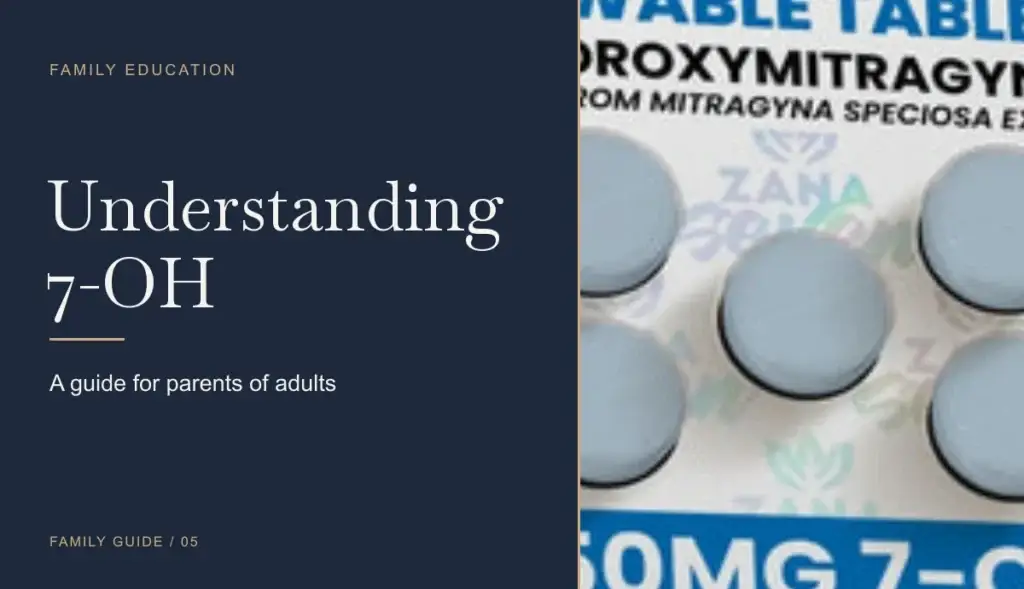
Your adult child may describe a small tablet or shot as a supplement. You may see “7-OH,” “7-hydroxy,” or an unfamiliar product name on a receipt and not know where to begin. The first useful question is what they are actually taking. The next is whether they are safe now.
A store display does not tell you how a substance works or whether it is appropriate for a health condition. Families should distinguish product claims from verified information. You can take the risk seriously without treating your adult child as dishonest simply because they believed the marketing.
What is 7-OH?
7-hydroxymitragynine, often shortened to 7-OH, is an alkaloid found in trace amounts in kratom. The FDA’s specific concern includes products with added or enhanced amounts of 7-OH. These concentrated products have opioid activity and are not interchangeable with unenhanced botanical leaf. FDA advises consumers to avoid them (U.S. Food and Drug Administration [FDA], 2025).
The distinction matters when your child says, “It’s just a plant.” A product’s relationship to a plant does not establish the composition or effects of a manufactured tablet. Ask to see the actual label, but remember that a label is not a laboratory analysis.
Why families may miss the problem
Small packages, online delivery, and descriptions such as mood support can make a product seem ordinary. A person may begin using it for pain, energy, or to manage discomfort from another substance. That history is useful for a clinician, even if the family disagrees with the decision.
Avoid making the conversation a contest over whether the store should have sold it. Focus on current needs. Is your child taking it repeatedly? Are they worried about feeling sick without it? Has spending or missed work become a problem? Ask these questions directly rather than drawing conclusions from packaging alone.
What the warnings mean—and do not mean
FDA has reported concerns including addiction, sleep problems, gastrointestinal distress, seizures, and withdrawal symptoms. It has also issued warning letters about unlawful marketing. These warnings do not tell you exactly what is in a particular product or predict what will happen to one individual (FDA, 2025).
Do not use a headline comparing potency to another opioid to calculate a “safe” amount. Products and routes differ, and this article does not provide a dosing guide. Regulatory actions also change. Availability in a particular shop should never be used as proof of legality or safety.
Ask about use without demanding a confession
Try a conversation built around an observed event: “You said you felt sick when you ran out, and that worries me. Would you talk with a clinician about it?” Ask what they understand about the product and what they hope it is helping. Listen for a concern you can help address, such as fear of missing work or a prior bad treatment experience.
Do not make agreement about the word “addiction” a prerequisite for an appointment. “Let’s find out what support you need” may be a more achievable first step. An adult child can disagree with your interpretation and still accept a medical evaluation.
Choose one family spokesperson for the initial discussion if several relatives are involved. A surprise group interrogation can distract from the practical request. If past attempts have become unsafe or repeatedly stalled, seek professional planning rather than escalating the pressure on your own.
Recognize urgent symptoms
An unresponsive person, abnormal breathing, or a seizure needs emergency help. Call 911 and describe the possible product exposure. For suspected opioid overdose, administer available naloxone according to its instructions and follow the dispatcher’s directions. Stay with the person; apparent improvement does not eliminate the need for medical evaluation (Centers for Disease Control and Prevention [CDC], 2025).
For exposure questions without an immediate life-threatening emergency, U.S. Poison Control is available at 1-800-222-1222. Keep the packaging available if safe. Do not wait to obtain the exact brand or ingredient concentration before calling for help (FDA, 2025).
Do not improvise a withdrawal plan
Parents sometimes feel they must choose between buying more product and demanding immediate cessation. A qualified clinician can assess the situation and recommend a safer path. Explain what has been used, how often, and whether alcohol, prescribed medicines, or other substances are involved.
Do not create a taper from internet advice, borrow medication, or substitute another gas-station product. If your child reports withdrawal symptoms, help arrange prompt clinical advice. Family support is valuable, but it is not a replacement for medical management.
Ask the provider what to do if symptoms worsen before the appointment. Knowing the escalation plan can reduce the temptation to improvise when everyone is tired or frightened. Keep the instructions where the person and an agreed support contact can find them.
Support without becoming the entire care system
Offer a small number of concrete choices: a ride to an assessment, help making calls, or assistance with agreed appointment costs. If you provide financial help, clarify the purpose and limits in advance. Paying a provider directly may be more workable than repeated unexplained transfers.
Think through your household responsibilities separately from treatment decisions. You may need arrangements for children, driving, or shared bills even while your adult child considers care. A boundary should describe an action you can maintain. It should not depend on your ability to control another adult’s thoughts or guarantee abstinence.
Questions for a treatment provider
Ask whether the clinician has experience assessing kratom-related products and emerging substances. Discuss co-occurring health needs, available levels of care, and what follow-up looks like. A program should explain its services clearly, including what it cannot provide.
Before committing to a plan, ask who will coordinate medications, appointments, and discharge information. Confirm costs and any insurance questions directly with the provider and insurer. A persuasive admissions conversation is not a substitute for an individualized assessment.
Where ClearRoute fits
ClearRoute offers family education, intervention planning, and treatment placement support. Those services can help a family organize its response and navigate care. Medical stabilization and prescribing belong with licensed healthcare providers.
If you are unsure how to approach your adult child, start with a consultation. Bring the situation as it is: what you have observed, what your child has said, and which decisions feel most urgent. A useful plan begins with those facts, not a perfect explanation of every product.
What changes if the person using 7-OH is a teen?
ClearRoute supports parents of teens as well as parents of adult children. If you suspect a teen has used a 7-OH product, address possible exposure immediately and involve their pediatric or adolescent healthcare provider for follow-up. With an adult child, offer an assessment and ask what involvement they want from you. In either case, let clinicians guide withdrawal care; a family’s job is to connect the person with qualified help.
Frequently asked questions
Is 7-OH the same as kratom?
No. Kratom naturally contains trace amounts of 7-OH, but enhanced or concentrated 7-OH products differ from ordinary leaf preparations. Neither should be assumed safe from a plant-based label.
Is 7-OH an approved treatment for pain or withdrawal?
FDA states that there are no FDA-approved 7-OH products for these or other medical uses. Ask a qualified clinician about appropriate treatment options.
Should I give money to prevent withdrawal?
Seek prompt medical advice rather than making product purchases the family’s withdrawal plan. You can offer direct help arranging or attending an assessment.
What if my adult child refuses to show me the package?
You can still describe your observations and seek family guidance. In an emergency, tell responders what you know without delaying help to obtain more details.
Can a family consultation happen before treatment is accepted?
Yes. ClearRoute can discuss communication, boundaries, and planning while your loved one is considering an assessment.
Sources
Centers for Disease Control and Prevention. (2025, June 11). Lifesaving naloxone. https://www.cdc.gov/stop-overdose/caring/naloxone.html
U.S. Food and Drug Administration. (n.d.). FDA and kratom. https://www.fda.gov/news-events/public-health-focus/fda-and-kratom
U.S. Food and Drug Administration. (2025, July 15). FDA issues warning letters to firms marketing products containing 7-hydroxymitragynine. https://www.fda.gov/news-events/press-announcements/fda-issues-warning-letters-firms-marketing-products-containing-7-hydroxymitragynine
U.S. Food and Drug Administration. (2025, July 29). Products containing 7-OH can cause serious harm. https://www.fda.gov/consumers/consumer-updates/products-containing-7-oh-can-cause-serious-harm
Educational information; not a diagnosis or an individualized treatment plan. For an immediate medical emergency, call 911.
Featured photograph: Product photograph: Zana Herbals; cropped for educational illustration. Image source.