
Key points
- Cannabis edibles can take longer to cause noticeable effects, making accidental overconsumption a concern.
- Familiar-looking candy or drink packaging does not establish contents or strength.
- Suspected exposure, family conversation, and ongoing treatment planning are different tasks; handle safety first.
An unfamiliar gummy package may look less alarming than a bottle of liquor or a loose pill. That appearance can make it harder for families to recognize a concern. A teenager may view an edible as ordinary candy with a different ingredient, or may not know what a shared product contained.
The most useful response begins with a few questions: Has anyone eaten it? When? Are they having symptoms? Is the package available? You can address household rules later. During a possible exposure, accurate information matters more than an immediate explanation of how the product got into the home.
Why edibles can be unpredictable
Edible cannabis has different timing from inhaled cannabis. Effects may take 30 minutes to two hours to become noticeable and may last longer than expected. Someone who assumes “nothing happened” may consume more before the first amount takes effect. Labeling and actual THC content can also be uncertain (Centers for Disease Control and Prevention [CDC], 2024).
These timing differences are not instructions for experimenting. They explain why a teenager’s early reassurance that they feel fine cannot settle an exposure concern. Ask Poison Control or a healthcare professional for advice instead of relying on a countdown found online.
What families may find
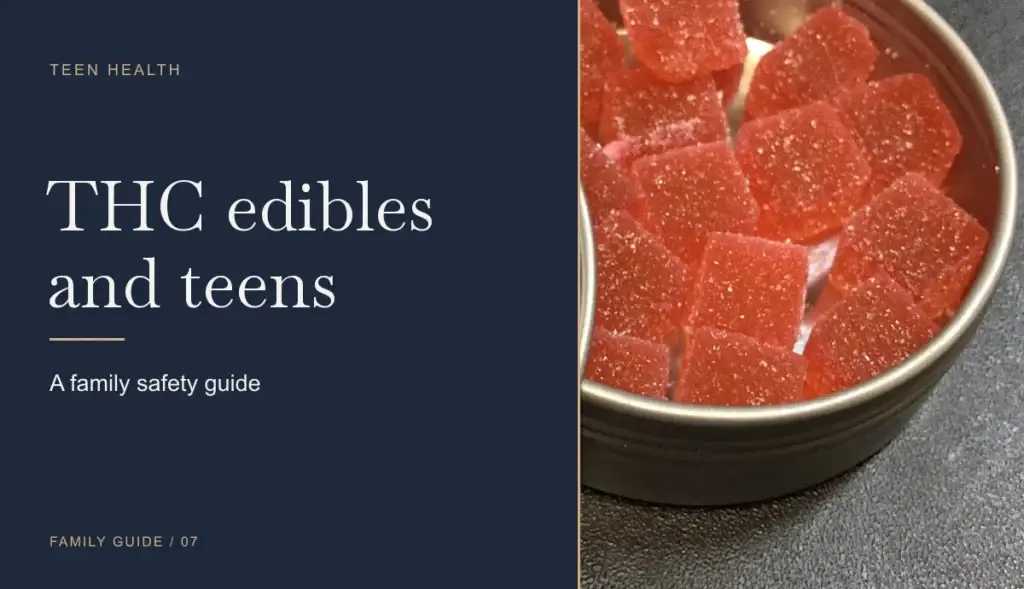
THC can appear in gummies, baked goods, candies, and beverages. Some packaging resembles familiar snacks. Product names and flavor descriptions are not reliable measures of what is inside. A loose gummy is especially difficult to distinguish from ordinary candy by sight.
Do not taste an item to test it. Keep the package, ingredient information, and any remaining product away from children and pets while seeking advice. If multiple people shared it, tell the professional advising you. Do not assume everyone will have the same reaction.
When to seek urgent help
Call 911 if someone cannot be awakened, has trouble breathing, has a seizure, or develops severe symptoms. Tell responders what may have been consumed and whether other substances were involved. For suspected exposure without an immediate emergency, call U.S. Poison Control at 1-800-222-1222 for individualized guidance (CDC, 2024).
Do not leave an impaired teenager alone to drive, shower, or “sleep it off.” Stay nearby and follow professional instructions. A quiet environment may help reduce distress while waiting for advice, but it does not replace assessment. Avoid giving alcohol, sedatives, or home remedies to counteract the effects.
Talk after the immediate concern has passed
A frightened parent may want answers immediately. Once safety is addressed, wait until your teenager is sober and able to participate. Ask what they believed the product was and what they expected it to do. That may reveal a misunderstanding, peer pressure, or an ongoing pattern.
Use a clear opening: “I want to understand what happened, and I want a plan so this doesn’t happen again.” Ask one question at a time. A conversation about the source, frequency, and circumstances will usually be more informative than a lecture about every possible future consequence.
Keep the expectation clear: THC use is not a safe activity for adolescents. You can state that without humiliating your teen or comparing them with siblings. Explain that calling for help in a frightening situation remains the right action, even when a rule has been broken.
What repeated use can affect
Cannabis use during adolescence can affect attention, learning, memory, and coordination. Mental health concerns also deserve attention. Associations with problems are not a prediction that every teen will have the same outcome, but they support taking regular use seriously (CDC, 2024).
If your teen says they use edibles for anxiety or sleep, arrange an assessment that addresses those concerns directly. Do not assume the explanation is either proof that cannabis helps or an excuse to dismiss. A qualified clinician can assess symptoms, substance use, and suitable treatment together.
Distinguish an incident from a pattern
One discovery does not tell you how often your teen uses. Ask about the weeks before the incident, not just that evening. Have they tried to stop? Are they using alone? Have activities or responsibilities changed? Does use continue despite problems?
Difficulty controlling use and continued use despite consequences are reasons for a clinical evaluation. Cannabis use disorder is assessed through a pattern of symptoms and impairment, not the number of packages a parent finds (CDC, n.d.).
Write down a few observations before the appointment. Include what your teen says as well as what you have seen. This reduces the chance that the visit becomes a contest between two versions of events. Ask the provider how the family can support follow-through.
Store adult products responsibly
If adults keep cannabis in the home where it is permitted, store it securely, out of children’s sight and reach, in its original clearly labeled packaging. Do not put cannabis edibles beside ordinary snacks or in a shared candy jar. Child-resistant packaging is not a substitute for secure storage (CDC, 2024).
Talk with other caregivers about the same expectations. A grandparent’s bag, a visitor’s purse, or a shared refrigerator can create access even when the main household cabinet is secure. The discussion should be specific and practical rather than based on blame after an incident.
Build a family response that can last
Decide how your teen will contact you if they feel unsafe, how transportation will work, and who will arrange follow-up. Avoid relying on a sweeping promise that there will never be another problem. A plan should say what happens if there is one.
Review routines with the treating professional when needed. School attendance, sleep, social activities, and family communication may all need attention, but they do not need to be solved in a single weekend. Choose a small number of priorities and revisit them regularly.
Parents can also seek support separately. You may need help deciding how to set limits, how much to tell other relatives, or how to respond when adults in the household disagree. A coordinated response is easier to maintain than alternating between strict punishment and ignoring the issue.
ClearRoute support for parents
ClearRoute provides family coaching and education to help parents prepare conversations and practical boundaries. Treatment placement support can help families navigate options when a qualified clinician recommends additional care.
ClearRoute is not an emergency or pediatric medical service. If you are concerned about ongoing THC use and want help organizing the next step, request a consultation. Bring your questions about communication, appointments, and family participation—not just the name of the product.
If your child is an adult and you find THC edibles
The teen brain-development discussion above is specific to adolescence. For an adult child, focus on possible exposure, impaired driving, and the effect on daily life. Offer to help contact a clinician and ask how they want you involved. For a teen, arrange appropriate adolescent care and discuss secure storage with other caregivers. ClearRoute helps parents of both teens and adult children plan conversations and family support.
Frequently asked questions
Can ordinary-looking gummies contain THC?
Yes. Appearance alone cannot establish whether a gummy contains THC or how much. Keep uncertain products away from children and seek advice after a suspected ingestion.
What if my teen feels fine right after eating one?
Edible effects can be delayed. Contact Poison Control for exposure advice rather than waiting for symptoms or assuming an early lack of symptoms means safety.
Are THC drinks different from edibles?
They are another ingestible cannabis format. Contents and effects vary, and a familiar beverage package should not be treated as proof of safety.
Does every teen who tries an edible need addiction treatment?
No. A clinician should assess the circumstances, safety, pattern of use, and functioning. One incident still warrants a thoughtful conversation and appropriate follow-up.
Can secure storage replace talking with my teen?
No. Storage reduces access risks, while an ongoing conversation addresses choices, concerns, and how to get help. Families need both.
Sources
Centers for Disease Control and Prevention. (2024, February 15). Cannabis and poisoning. https://www.cdc.gov/cannabis/health-effects/poisoning.html
Centers for Disease Control and Prevention. (2024, February 15). Cannabis and teens. https://www.cdc.gov/cannabis/health-effects/cannabis-and-teens.html
Centers for Disease Control and Prevention. (n.d.). Cannabis frequently asked questions. https://www.cdc.gov/cannabis/faq/
Centers for Disease Control and Prevention. (n.d.). Understanding your risk for cannabis use disorder. https://www.cdc.gov/cannabis/health-effects/cannabis-use-disorder.html
Educational information; not a diagnosis or an individualized treatment plan. For an immediate medical emergency, call 911.
Featured photograph: Photo: Sarah Stierch. Cropped and typeset under CC BY 2.0. Image source.